Thursday, 4 September 2014


Saturday, 30 August 2014
Ma
Here
is a sentence (from this web page) that stopped me in my tracks:
“Ma is a concept of absence and in-between … a departure from a way of looking that privileges the tangible.”
Oh my goodness.
I had never
properly grasped, until I read that sentence, in our Western culture, just as
we privilege the “white” and the male, we also privilege the tangible.
Seeing that
suddenly makes ten thousand things fall into place.
This is what I
am working at/for – a life that no longer privileges the tangible.
I found that
web page while rooting around investigating the word ma.
The Japanese
have, it seems, a word for each of the things I treasure most.
Komorebi ~ the
interplay of light and shadow made by the sun shining through leaves.
And now ma ~ written in three slight variants:


There’s a good
article about it on Wikipedia, too.
Gosh. All that and Zen and Macaque monkeys! Oh, I love the Japanese!

Friday, 29 August 2014
Floor life.
Sleeping
on the floor – in fact living on the
floor – is a revelation.
I’m
intrigued by the extent to which manufactured objects have slowly but surely
taken over our lives, so that people talk about ‘going to bed’ not ‘going to
sleep’. I mean, I know they still say ‘going to sleep’ – but bed is where you have
to do it.
I’m
interested in creating a portable life. I’ve got my personal belongings down to
what will fit in a medium-sized suitcase now, and have turned my attention to
what my requirements would be of any place I took that suitcase. What else
would I need? How small could I live? How little could I ask of a place, to
settle there and call it home?
I’d
need an electric supply, but one socket would do the trick. Somewhere to charge
my lap-top and kindle and phone – oh, by the way, I didn’t keep that iPhone. I
was beginning to feel swamped by electronics, gradually absorbed and digested
by a world of wires. Tangled up. And more accessible than I wanted to be. Email
provides all I need, in terms of accessibility. It lets you stay a little
higher up the mountain.
Lights? In the winter you need lights. I have an LED string of tiny fairy lights that give me all the ambient light I need. They just wind up round the battery when it's time to move on - the whole thing no bigger than a pack of playing cards. I keep a rubber band round it, to hook it up to a nail in the wall, and string out the lights from there.
Lights? In the winter you need lights. I have an LED string of tiny fairy lights that give me all the ambient light I need. They just wind up round the battery when it's time to move on - the whole thing no bigger than a pack of playing cards. I keep a rubber band round it, to hook it up to a nail in the wall, and string out the lights from there.
I’d
want a source of water – a standpipe would do fine, or a sink and tap would be
handy. A bathroom would be nice. Some sort of sanitary arrangements an obvious
necessity.
I’d
need big windows, ones that open, because I have to be able to see the sky and
breathe the fresh air.
And
I can’t imagine life without a living fire; so, a fireplace.
I
think, now, that’s all I’d need. I have my suitcase of clothes and bits &
bobs. I have a sleeping bag, blanket and cushion. I have a tiny wood-gas stove
that packs away into a little saucepan and can run on twigs or wood-pellets or
torn up packaging or whatever’s to hand – or accommodate a tin of chafing fuel,
which has the handy advantage of not leaving a layer of soot on the pan. And I
have my little kettle and a hot water bottle and a thermos flask.
That’s
all I’d need. I’d pop into Marks and Spencer and buy a ready-made salad – which
would furnish me with a permanent bowl until it was time to move on. I have a
knife and fork and spoon tucked away in my suitcase.
Et
voilà! Instant life.
No
removal van needed. I think I’d need a car, to get to that place. A suitcase,
sleeping bag, blanket, cushion and small bag containing kettle and saucepan do all amount to a surprising lot to wrestle
on and off a bus.
And
the place? A shepherd’s hut in a field by a wood, maybe. A one-roomed apartment
with a bathroom would be fine – provided I was allowed an open fire. Flats can
be difficult about fires.
I
would like my life to be even more portable. Think of Peace Pilgrim!
Astonishing! How did she do that? I can’t manage it. I’ve wriggled my way down,
shedding more and more, and this is as low as I can get. At the moment anyway.
I like the idea of being able to get my life into a rucksack, with a sleeping
bag that just rolls up and straps onto the bottom of it – but those sort of
sleeping bags aren’t very warm, are they? I mean, why bother? Why not just put
thick clothes on to go to sleep? My sleeping bag is capacious and cosy, and
consequently rather large when I roll it up.
It
took me a while to get used to the idea of sleeping on the floor. First I got
one of those breathing camping mats – I mean the kind that suck in their own
air. That’s very comfy. It’s handy if you are actually camping because the
ground is so cold and the mat provides insulation. But I discovered you don’t
need it in a house. Or in a shed. I thought the wooden floor in Komorebi would
be uncomfortable to sleep on. But it’s the idea,
really, that has to be overcome. Once you manage to struggle free of the
clinging concept that you absolutely need a bed and can’t possibly be
comfortable without one or get a good night’s sleep – well, it turns out just
to be not true. If you lie down on the floor with no concepts and no self-pity,
you sleep perfectly well. It sorts out a lot of ailments, too.
What
I find really, really exciting about floor living is the
S
P A C E ! ! !
Furniture
is so cumbersome and claustrophobic.
My
beautiful mama wants to have her carpet cleaned. When the men come in to do
that, they will expect the rooms to be cleared – at least one room. And how’s she going to do that? Every room in her apartment
is stuffed to the gunwhales with sofas and armchairs and bureaux and tables and
coffee tables and little stools and chests of drawers and trunks and occasional
chairs and hat-boxes and ornaments and pot plants and baskets and stools and
aaaaaagh! Aaaaaagh!!!
Floor.
Person. And a sleeping bag handily rolls up into something you can sit on or
lean on in the day, if – like me – you are not so much of a sitting up straight
sort of person and more kind of floppy.
Oh,
the uncarved block of infinite possibility, the childish delight of sleeping
anyway round or in any part of the room, in any room of the house – hahahaha!
It’s such fun!
Last
winter, sad, I turned back to look at the dying embers on the hearth when it
was time to ‘go to bed’, and wished I could sleep by the fireside. This winter,
I will.
Thursday, 21 August 2014
Dom Anu
I had this surprising
dream.
Heheh – even writing
that makes me smile, because there’s this wonderful poem Buzzfloyd wrote:
Rondeau redoublé – An Anecdote Unwanted
Please don’t tell us your dream.
As you bend my poor ear,
I’m trying not to scream.
Nobody wants to hear!
I wonder why I’m here,
Watching you fondly beam.
We could be stuck here all year –
Please don’t tell us your dream.
As you warm to your theme,
You then shift down a gear,
Detailing every scheme
As you bend my poor ear.
Please let the end be near!
I see how your eyes gleam
While mine threaten a tear;
I’m trying not to scream.
Did this, at some point, seem
Relevant – the point clear?
This is a mutant meme
Nobody wants to hear.
Please don’t tell.
Hahaha! Always makes me laugh!
Anyway – tough – I’m going to tell you about my dream.
I think what triggered it was my beautiful mama telling me yesterday that
Songs of Praise on the telly came from Ampleforth last week – the Benedictine
monastery in Yorkshire that’s more or less in the place where St Alcuins is in
my Hawk & Dove novels. In my misspent youth I studied at York University
and was part of an interdenominational lay community there. Father Fabian Cowper (an Ampleforth monk) was our chaplain, and he was the university’s Roman
Catholic chaplain. Fabian was one of the kindest people I’ve ever met, and I
saw the Christlight shine through him (I mean that literally). We visited at
Ampleforth sometimes, and it has a special place in my heart. So when I
discovered I’d missed watching Songs of Praise from there it triggered a
certain electrical twitch of some kind in my brain which probably accounts for
the dream.
Because I dreamed I went to Ampleforth. It had been Christmas – which is
(I hope you know this) not, as some
people mistakenly think, the feast of Christ’s birthday, but the feast of the
Incarnation. Those two things are understandably easily confused but not in
fact the same. So, in my dream it had been Christmas, and I’d been sent
Christmas cards and gifts from two or three Ampleforth monks. This is not a
thing that in real life ever would happen. I have been in brief correspondence
with their abbot, and he and some of the Ampleforth monks have read my books,
and the abbot spoke graciously of them – but there is none of them would think
of me even as an acquaintance let alone a friend.
But in my dream, I’d had letters/cards at Christmas, thanking me for my
books and saying they liked them. One was from the Infirmarian – and I think I
knew his name in my dream, but it eludes my memory now.
This Christmas correspondence included a special gift from Dom Anu. I have
never called a monk “Dom”, though it is a title the Benedictines use. In our
lay community we had some breviaries from deceased monks, with their names in,
and they would all be “Dom Gregory Brown” and “Dom Hugh Moore” (made up names)
and so on.
We would say “Father” in English – “Father Gregory Brown”. “Dom” is short
for Dominus, which is Latin for “Lord”.
And in my dream, I had this gift from Dom Anu. It was a small stained
glass panel. Apparently Dom Anu was (in my dream, I mean) a stained glass
artist, and he chose something he made, to send me.
The panel was leaded, and made of roughly rectangular pieces of brownish
glass – a central piece surrounded by smaller pieces, of which one had a short
poem/poetic extract painted (and presumably fired) on, in italic script. I
don’t remember reading it in the dream, and don’t now know what it said, but I
know it related to the central section of the panel – a cleverly chosen piece
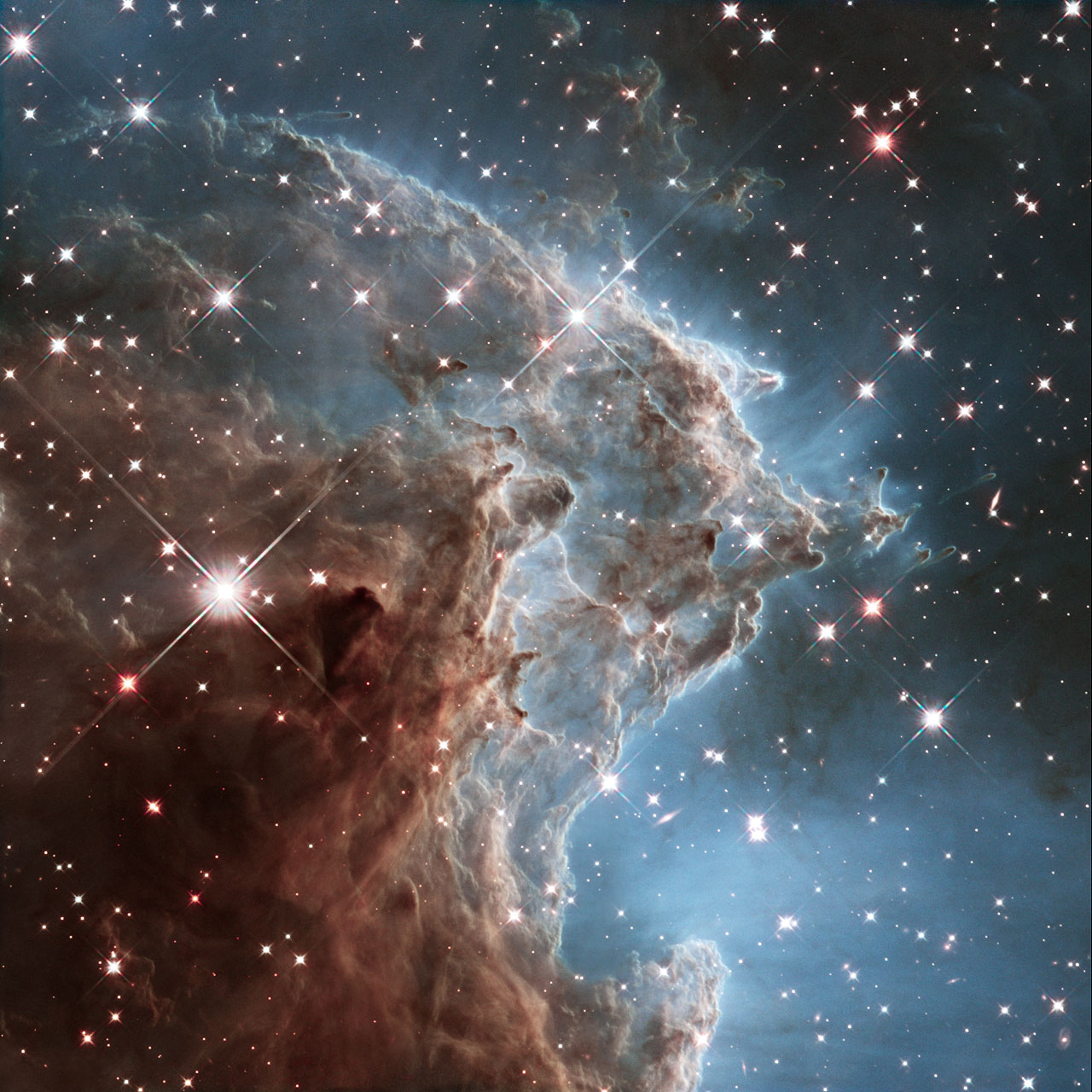
of glass representing the starry sky, the universe. It looked like one of those
pictures you get from the Hubble telescope – something like this (described here). And I know that’s what the poem was about
too, but don’t know what it said.
I was delighted with this gift. It was beautiful and unusual and
wonderfully crafted. And Dom Anu had sent it with a message to say that he
loved my books, and thank you for them. But apparently Dom Anu didn’t speak
English, so one of the other monks had written the letter for him.
Then in my dream I visited Ampleforth, and I wanted particularly to meet
the Infirmarian, and Dom Anu, because they had written to me. I wasn’t so
interested in the monk who’d written the actual letter for Dom Anu, because he
was only representing Dom Anu really.
I think I did meet the Infirmarian briefly, but I can’t properly remember
that now. But then in the refectory (in the guest house I think, because the
table was crowded with lots of people who were not monks) I was introduced to
someone I took to be Dom Anu (one has to wonder why, since I’d never met him).
I reached out to shake his hand and thank him for his lovely letter and gift.
And he said he was not Dom Anu, but he was the monk who had written me the
letter on Dom Anu’s behalf, and his name was Christopher.
He was a Benedictine monk, but I think he didn’t say “Father Christopher”
(and certainly not “Dom”) just “Christopher”.
Some more details and conversation followed, but this could go on forever so I won't tell you all about that – briefly, the conversation was evaluating the differences and similarities between
marriage and monastic community, and took place with me, a couple of monks, and
my parents-in-law from my first marriage who were sitting with me in a large
bed. I suggested that the primary requisite for both marriage and monastic
community was kindness.
And then I woke up.
Filled with curiosity about the name Dom Anu, I wondered if Anu is, in
fact a name or word in any language. I looked up Anu and got nothing useful. I
typed “Anu” into Google translate and got . . . “Anu”.
Then I searched on Anu + name. Well, it does exist. Anu, it turns out, is
the God of Heaven, a sky-god, lord of the constellations, inhabiter of the
highest heavenly realms. This is in Sumerian, Assyrian and
Babylonian mythology, none of which I have ever read, studied or come across in
any way, shape or form whatsoever.
And Christopher means, of course, “bearer of Christ” or “He who holds
Christ in his heart”, from the Greek Christophoros. The “phoros” part of that
word means “to bear” – not in the sense of “to carry”, which you might think
from the legend of St Christopher carrying the Christchild over the river, but
in the sense of “to bear fruit”, to be fruitful. So, it means more like Christ-revealer than Christ-carrier, though I didn't know that until I looked it up this morning.
Having looked all this up, I sat in bed thinking. Gosh. Whoever was it I
met last night? I’m jolly glad they liked my books. Well – Dom Anu anyway.
Christopher was only speaking on his behalf (which I think was always the
case).
Thursday, 14 August 2014
"Even"

The
three pillars of Gandhi’s philosophy of life:
Satyagraha
Ahimsa
Brahmacharya
The
satyagrahi – who practiced satyagraha – were those who gripped truth with a
firm hold. Satyagraha has been translated as “strength through truth and
love”. It resonates with the Quaker
concept of “speaking truth to power”. It’s at the heart of Gandhi’s non-violent
resistance – civil disobedience – as a means of reforming corrupt society.
Ahimsa
is described usually as non-violence. That’s a negative term, and ahimsa is a
positive thing. It has tenderness. It is the insight that all living beings are
members of our family. It lives kindly in the world. It resonates with the
beautiful words of the Buddha in the Metta Sutta. This is described as "the Buddha's words on loving-kindness", and that positive description offers a better understanding of Ahimsa than the more negative term "non-violence"; it's more than that. Gandhi’s vegetarianism was
part of his practice of ahimsa, and he required it of those who followed him.
Those
two aspects of his teaching and practice are the well-known ones: Gandhi,
vegetarianism and nonviolent protest, could be a fair summary of what most
people know about him. He made the words ahimsa
and satyagraha widely known in the
West even if not exactly common parlance.
But
what about the third pillar, Brahmacharya? Brahma
is “God” and charya is “conduct”. Brahmacharya is the renouncement of all
worldly things in orientation of one’s life around God. It’s like Jesus said,
you cannot serve God and Mammon. You have to choose. Gandhi thought so too. He
saw everyday life as religion; “My life is my message,” he responded to a
journalist who begged him for a quick statement of his message, as the train he
had boarded was starting to pull out of the station. How you live can in no way
be separated from what you believe. In a sense, there is no such thing as
hypocrisy. How you live simply reveals what you believe in your heart, no
matter what persona you may choose to hide behind. Though of course, we all do
stumble and fail. Expecting perfection is unrealistic. One has to work
patiently with human nature. Brahmacharya also often means “celibacy”, and I
believe Gandhi did become celibate as part of his renunciation of the world,
but I don’t think he required it as an essential for following him.
As
an expression of Brahmacharya, Gandhi insisted on simplicity in his ashrams. He
said:
“Whoever
joins me must be ready to sleep on plain floor, wear simple clothes, get up
early, live from undemanding nutrition and even clean his toilet.”
Well,
when I was reading about Gandhi and his philosophy, I was nodding along – yes,
yes – everything seemed normal and as expected until I came to that word “even”
– as in, “even clean his toilet”.
Why
it arrested my attention, startled and intrigued me, is that the word “even”
identifies it as, in Gandhi’s view, the most extreme thing on his list. A
further reach to attain than sleeping on the floor, getting up early, plain
dress and eating veggie.
What’s
odd about that, to me, is that cleaning the toilet after you’ve used it is the
only thing either you do it yourself or someone else has to do it (assuming
it’s a shared toilet – most are). If you get up late and have a penchant for
fancy threads, I don’t really see how that has any impact on anyone but
yourself. But the toilet you don’t clean is a filthy job passed on.
The other things on Gandhi's list take a bit of work and thinking about for me; but all my life I have cleaned toilets for both myself and other people. If you are a
woman, and especially if you are a mother, I bet you have too.
The day Gandhi started cleaning his own toilet was the day someone else could stop. A
woman, probably. Though Gandhi did have a big domestic row over this, when he
insisted that his wife also take her turn at cleaning the toilet and she cut up
rough – because in India it would have been a dalit’s job. It was a huge caste
statement for them, an act of humility for which I think we have no true
comparison.
So
that interested me.
“Even”.
A little word can say a lot.
Subscribe to:
Posts (Atom)