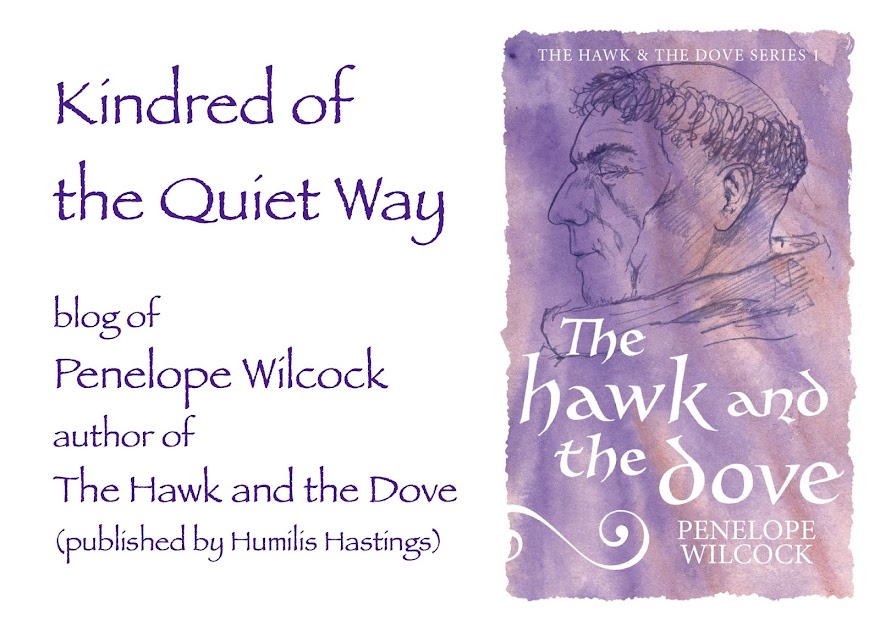
The
next two books of The Hawk & The Dove series will be out in February, and
are up for pre-order on Amazon now.

The Breath of Peace is the one I published
privately for a while, during the change-over of this series between my US and
UK publishers. The Beautiful Thread
is all new.

The
Beautiful Thread is a consideration of kindness as the heart of Gospel practice.
Here’s an extract from the story (Abbot John is addressing the community in Chapter) ~
The next day dawned sparkling and
unclouded. Keeping close to the solid, imposing wall of the church, noting that
the small door had indeed been left ajar, William found his hiding place, from
where he could hear remarkably clearly – the brethren shuffling in, the reading
from Benedict’s rule, and then the abbot’s voice, steady and firm, carrying
conviction but, William thought, entirely devoid of joy.
‘My
brothers, there’s something I want to say to you. Not very polished. Only
what’s been on my mind. Something about suffering.
‘You
might think a man like me has not suffered enough to deserve an opinion, and if
so you’d possibly be right. My life so far has been, by comparison with many
others, easy. I was never destitute, nor subject to the cruelty of human
violence. Even so, I have occasionally descended into hopelessness.
‘When
the example of holy suffering is held before us – Christ on the cross, or the
holy martyrs – the word ‘noble’ seems to apply. So, we give thanks for ‘the
noble army of martyrs’. Sawn in two, torn to pieces by lions, stoned to death .
. . giving thanks to God, and holding their heads high in courage. Noble.
‘Well,
I’ve never been anything like that, I’m not noble at all. The worst wild animal
that’s ripped into my viscera has been the profoundest sense of inadequacy you
can imagine. To be a failure, as a monk, as a disciple, as a man. Sometimes
I’ve thought. Painful. So very painful.
‘In
this, the hardest, most terrifying thing, left me in free-fall, has been a
feeling of absolute pointlessness – that it was all for nothing. Not noble, but
not even useful, not directed or channeled into any worthwhile endeavor. Only
the result of being human, being alive. Pointless.
‘When
I reflect on this, a picture of Christ on the cross comes to mind – ‘My God, my
God, why have you forsaken me?’ It seems even he encountered that terrible
state of meaninglessness, where what you thought it was all for simply
evaporates. And then, his words, ‘I am thirsty.’ The unadorned human condition,
taken down below the embellishment of values, beneath the complication of
mission, without the dignity of significance. Just thirsty.
‘Obviously,
there are no options beyond living through such times. If I look at myself and
see no achievement worth mentioning, see only one great big immoveable
disappointment of a man, aspiration deflates.
‘But
my job here is not to share around a council of despair. That wouldn’t be very
helpful, would it? So gazing into it bleakly, I have to pull out of it
something to place into your hands – your hearts – because you trusted me. You
made me your abbot, and that means it’s my job to come up with something. I
hope I’m not speaking too frankly. As you can probably tell, I haven’t prepared
this.”
Tom
raised his head and looked across the room at his abbot, concern in his face.
This didn’t sound too good. But John, his hands held loosely in his lap within
the big sleeves of his habit, sitting quietly straight, did not meet anyone’s
gaze. His eyes seemed to see nothing.
‘And
I prayed, “Help me, Jesus,” as I so often do. It’s never let me down, you see,
that prayer; never once. “Oh, help me, Jesus.”
‘And
what came to mind was two thoughts that have threaded through the last few
weeks, for one reason and another. I’m sorry; I’m not putting this well, am I?
Anyway: the first is, that whatever’s going on in my own life – whether my
faith is soaring and I’m overflowing with inspiration, or whether I’m in
despair; whether others look up to me or I am disregarded, of no account –
whatever – I have the option to be kind. It’s a small thing, you would think,
would you not, to be kind? Well, it is in the sense that you don’t have to be
rich or important, or very bright, to be kind. Even a little child can be kind.
Even a dog. But it’s no small thing to be on the receiving end of kindness. And
the withholding of simple kindness is a root of bitterness and the seed of war;
it causes the most terrible suffering. To look without compassion on another’s
life; to be unkind. Making the choice to be kind prays “Thy kingdom come,” even
when you feel past praying and past caring.
‘Kindness,
I have found, for all it is small and ordinary, has a way of leading me out of
safe territory. There’s nothing like kindness for compromising righteousness
and getting my religion and propriety all in a muddled knot. Kindness makes hay
of many plans. But it is, I have come to believe, the currency of Christ’s
kingdom, the stuff out of which new hope can be made. Where we push a sprig of
it into the earth in whatever place we are, life springs anew.
‘So
when all light is gone and the horrible sense of pointlessness overwhelms me,
showing me my own inadequacy, I can at least make the choice to be kind; and
that’s my prayer, my creed, my way of anchoring myself to Christ.
‘And
the other thing – it caught my attention when someone said it to me a few days
ago – is about offering the gift of happiness. That having the power to make
someone happy might be seen almost as a charism. Like working miracles. Like
healing.
‘In
once sense, of course, you cannot make anybody happy. Each of us is responsible
for developing contentment and gratitude, appreciation, as a state of mind.
Happiness – we all know this – is not a destination to be reached or a goal to
be achieved; it’s the choice you make, the path you tread, the attitude you
embrace. And that’s no small thing, either. Happy people make the world happy,
are good to be around, lift others up. Cheerfulness; it’s a kingdom thing:
‘Rejoice in the Lord always.’
‘But
a friendly word, reaching out to include someone, knowing their taste in food
and offering a nibble of something they enjoy – even leaving them in peace,
sometimes; there are so many ways to offer ordinary every gifts of happiness.
‘So
I thought, between choosing kindness and offering happiness, I could find
enough to be going on with, a ladder up out of inadequacy and despair. It
didn’t matter what I’d been or done, or who I was or who cared, who saw or who
knew. I could still do it. The thing is, when I feel really low, vision and
inspiration are beyond me. But, you know, even when almost everything seems too
much to manage, perhaps I can at least try to be kind. And I thought, that
could give some meaning, something worthwhile, even to the most impoverished
life. Even to mine. Sort of life compost, kindness and the giving of happiness
could be; something in which faith and meaning could potentially thrive. It is
only a small thing – I understand that. But sometimes I have to hope it will be
enough.’
His
friend sounded bleak and enduring, William thought, as he concluded with
complete absence of élan: ‘There’s no big scholarship there, no expositions or
dissertations or any of that. It just seemed useful to me; and so I thought it
might be to you, as well. Anyway, let’s keep silence a moment.’

