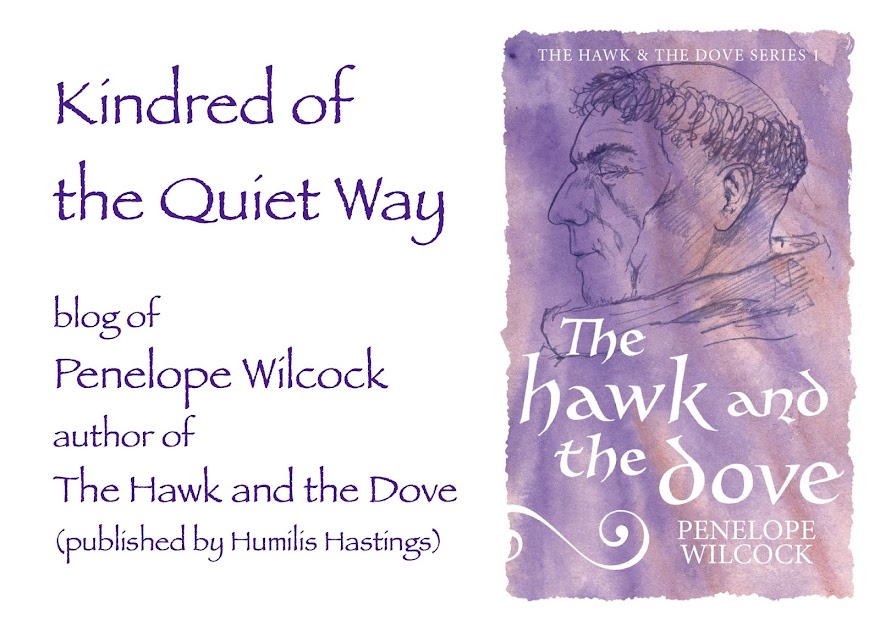
Over the course of time, I've written two books for people to read during Lent. One was The Wilderness Within You, which is about encountering Jesus in the context of everyday life, and the other is the fourth in a sequence of nine novels under the collective series title of The Hawk and the Dove. The Lent one is called The Hardest Thing To Do, and is mainly about seeing things from someone else's point of view.
It tells the story of Lent unfolding in a Yorkshire monastery one year in the fourteenth century. The community has elected a new abbot, Father John Hazell, who has a not altogether easy beginning to his new role.
There's an entry — not a chapter exactly — to each day of Lent, so that it can be read for lenten spiritual devotion. Here, for your enjoyment, is part of the Good Friday section:
THE FORTY-FIFTH DAY – Good Friday
Abbot John listened to the chapter, watched the reader return to his stall; and began to speak.
‘On Good Friday, I have nothing original to say. This seems to me not a time to be clever or innovative – to try to improve the tradition with audacious new thoughts of my own. I have no new thoughts. All my sight is filled with Christ upon the cross, nailed in stark suffering, waiting through agony for a glory he has almost lost sight of: “Eli, eli, lama sabachtani.”
‘Of all the Good Fridays I have sat in this Chapter House, keeping watch with you, my brothers, the one I remember most was five years ago. Before Father Peregrine was taken ill.
‘I remember him talking to us quietly, the way he always did. He spoke about how Jesus opened wide his arms for us on the cross; an embrace, Father said, that was big enough for everyone in the world. He said that the thing about being nailed to a cross, wide open like that, is that you are brought to a place where you can no longer change your mind. Do you remember that homily?
‘Father got a bit scholarly at this point! He spoke about the holy Name of God in the Scriptures: I Am That I Am. He drew our attention to the numerous times in the gospels – especially the gospel of John – where Jesus takes to himself that holy Name of God. I Am the Good Shepherd. I Am the Way, the Truth and the Life. I Am the Bread of Life. I Am the Light of the World. Father said, Christ was consciously aligning himself – for our benefit – upon the pattern of God’s nature and identity. He was conformed to the being of God the Father; by his choices, by his attitudes, and by who he essentially was.
‘But then, Father Abbot said that the heart of all this, the perfect living icon of God-in-Christ, becomes clear to us when we gaze upon Christ on the cross. Helpless, hurting, his arms spread wide; no longer able to even see or feel the presence of his God, no longer able to teach or choose, to challenge or heal, he is just nailed there. And his body announces the real presence of God, saying: “Here I Am”.
‘Father said, Jesus had stopped choosing for himself – he said when Christ opened wide his arms for us on the cross, that was anyone’s hug: friend, brother, enemy, betrayer – Christ was just there; it was over to us now to respond. This was the finale; the moment we decide whether we are religious sight-seers, pausing to look and then moving on – or whether we will stop, and hug him back. He reminded us, Christ is nailed to that cross. Those who jeered at him to come down from it saw no miracles. So anybody who accepts that embrace, hugs him back, has to accept the cross as well as the Christ.
‘Father said, we are the body of Christ, and we go the way of the cross. If we are drawn to him, if we are in love with him, what we do is embrace each other – without question, exception or reservation. In embracing each other, we find we have embraced the cross, but also the Christ.
‘He said; “Jesus opened wide his arms for you on the cross. It’s up to you. In each other, you have the chance to hug him back.”
‘I always remembered that. I can’t put it any better. It’s what seems to me to be true.’