Monday, 29 April 2024

Some news about The Hawk & the Dove series

 The Hawk and the Dove (the first series rather than just the first book) was published in the traditional way, with regular publishers, over the course of about thirty years.

I wrote the first book in the series — The Hawk and the Dove — in 1989, and Kingsway published it in the UK in 1990. In the US, it was published by Good News, back in Al Fisher's time. 

At that time, Tony Collins (whom I married about 20 years later) was just starting his Monarch imprint at Kingsway. He passionately believed in fiction as a carrier of ideas, and Monarch became the Kingsway fiction list. In the two years that followed, Kingsway published further books of mine under the Monarch imprint, including the next two Hawk & Dove books — The Wounds of God and The Long Fall.

My prayer partner Margery (who died in 2004) was a stained glass artist and banner-maker, and she did the cover picture for the Kingsway (Monarch) edition of The Long Fall. That became very special to me, because it was the last piece of art work she ever did. She was already growing old at that point, and her eyesight failed. It was while she was working on the cover for The Long Fall that the first signs of macular degeneration manifested; it developed very quickly, and her eyesight was functionally gone in a brutally short space of time. I felt so grateful and so proud that we were able to work together in that way before it was too late. Only rarely is a writer allowed to choose their own cover art, and it was because I had the blessing of working with Tony Collins at Kingsway that this opportunity came about. Meanwhile, I also wrote Thereby Hangs a Tale (short stories) for Kingsway, and a non-fiction book, Spiritual Care of Dying and Bereaved People out of the work I did for some years as part of a hospice chaplaincy team, published by SPCK. 

After those books (and a couple of others) I became immersed in working as a Methodist minister, and I was fully occupied with pastoring church congregations and wrote no more books for some years.

My first marriage ended when my husband left me for someone else. Among other initiatives, I wrote another novel — The Clear Light of Day — at that point; and again I asked Tony Collins to be my publisher. By that time Kingsway had closed down their fiction list, and Monarch had moved with Tony to Lion Hudson, who accordingly published The Clear Light of Day; David C. Cook took it for the United States.

I married again. My second husband died of an auto-immune condition a short while into that marriage. 

Another year went by and I learned that Tony's marriage was ending. While, of course, that is always sad news, it blossomed into a very happy thing because at that point our professional relationship became personal, and we married in 2006. His work as a publisher was based in Oxford, so I left my work as a minister in Hastings to move up-country and be with him.

Good News publishers still had the original Hawk & Dove trilogy, republished as a one-volume edition around the year 2000. I asked them how they'd feel about my writing a further novel in the series for 2009, since that would be 20 years in from when I wrote the first story, and they were keen to do that — so, now released from church pastoral duties, I wrote The Hardest Thing To Do, but that expanded into five further stories, bringing the series up to nine volumes.  In the same time frame I wrote some non-fiction books for Lion Hudson. Because Tony and I were now husband and wife, he had to recuse himself from the publishing decision and process in respect of my work, so I had a different editor at Lion Hudson for a few years. 

Then Good News began to close down their fiction list, so Lion Hudson expressed interest in acquiring the whole series, and thus it came back to the UK. 

In 2009 Tony and I moved back to Hastings where the rest of my family is based — a very happy move. Here we live in a shared house with two of my daughters, Hebe and Alice Wilcock, both freelance artists.

Eventually Lion Hudson was bought out by SPCK, and almost all my work (about 20 books) therefore came under SPCK's auspices. For a short while, at that point, Tony also worked with SPCK, and I wrote two books for them — Equality is Biblical and Into the Heart of Advent

As the years have gone by, self-publishing has become more realistic and enjoyable than once it was, and in 2020 I wrote Relinquishment, extending the thinking of my book In Celebration of Simplicity, written around 2008. We published Relinquishment with the Amazon Kindle platform, under our own imprint Humilis Hastings. Jonathan Roberts, a very gifted covers man from Lion Hudson, designed the cover for me and helped with formatting. Tony Collins edited for me, and Louise Stenhouse copy-edited. Good team!

In 2022 I became ill, and have since joined the ranks of the chronically ill. My life became much more limited, more contracted, but I could still write. So during 2022 I spent the summer writing This Brother of Yours and Brother Cyril's Book — more stories from St Alcuins Abbey where The Hawk & the Dove series is set. To avoid confusion, since SPCK had the first nine volumes, we published these as Series 2, under our Humilis Hastings imprint. Alice and Hebe did the cover art, Jonathan Roberts designed the covers using their work, Tony edited and Louise Stenhouse copy-edited. 

We were also able to recover the rights of a rewritten and much expanded edition of Spiritual Care of Dying and Bereaved People that BRF (Bible Reading Foundation) published around 2008, and brought this out with cover art by Hebe Wilcock under our Humilis Hastings imprint.

It felt very exciting to be working from home together like this — it reminded me of the way William Morris and friends worked in the Arts and Crafts movement. It has the same integration of work and friendship, and I love it.

And now, the next step of the journey.

SPCK has kindly agreed to give me back the rights to all my work. There are some non-fiction books that for the moment we will leave to one side, though we may republish them with Humilis Hastings in due course — but (I feel so pleased about this) we will be re-publishing in the Humilis Hastings imprint the entire first series of The Hawk & the Dove — all nine books.

Just today, the first one is ready — The Hawk and the Dove. Alice and Hebe Wilcock will be the cover artists for the whole series, and Jonathan Roberts is the designer and formatter. Tony Collins has edited and Louise Stenhouse has copy-edited. We will work through all nine books and publish them under our own imprint one by one as soon as we can get them done.

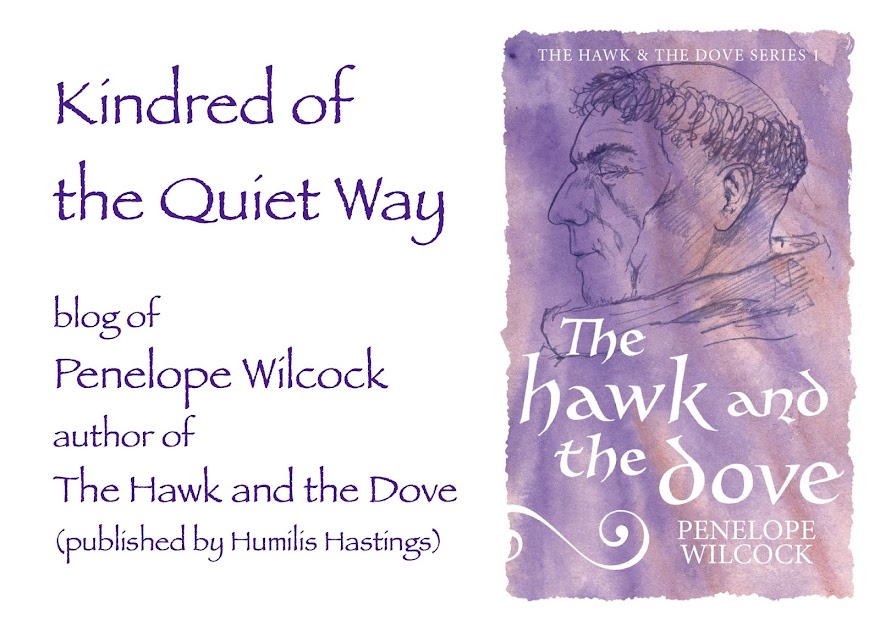
The cover will look like this, and it should be out on Amazon as an e-book and a paperback in the next few days.


This feels very satisfying to me.

Another very joyous aspect of this is the decision to split all proceeds from my book sales with the Carthusian community in West Sussex (I live in East Sussex, so they are not far away). The Carthusians are the closest it is possible for anyone now living to get to a medieval monastic community, because the Carthusian Rule has remained unchanged since the 11th century. Their share of my book money is sent to them as it comes in to me, so I don't deduct my publishing costs (fees for work done on text and covers) from that money — those costs come out of my half of the proceeds. The Carthusians are not allowed to be a charity, because their work is prayer and the contemplative pathway; therefore the Charities Commission deems them to be doing nothing useful so they can't be a charity and can't expand their income by reclaiming tax. But you know and I know that there is no more valuable work in all the world than to go on steadily with the unbroken service of prayer and adoration, and I am so proud to be able, even in this small way, to help towards it. I hope that makes you as happy as it does me. It gives me a sense of real contentment. Every person who buys a story of mine published under the Humilis Hastings imprint can know they are directly helping the Carthusian order continue in their path of contemplative prayer.

*        *        *

[For the friend in the comments having trouble finding this on Amazon Canada, it's here.]


*        *        *


[Edited 15th May 2025 to say for anyone landing on this page who doesn't generally follow this blog, you may like to know that there is now a third book in Series 2 of The Hawk and the Dove books — A Path of Serious Happiness, here on UK Amazon and here on US Amazon; and we are currently working on republishing the last 2 books in Series One (The Beautiful Thread, and then A Day and a Life).

My Amazon author page that shows you all my titles available is here on Amazon UK and here on Amazon US.

I hope that's helpful.]

Wednesday, 24 April 2024

Input for the April 2024 gathering of the Lantern Group


At our Lantern Group meeting this time, we thought about spiritual cleaning — cleansing and purifying, not housework!


We were looking at three areas:

  • Cursing and blessing.
  • Severance
  • The Ho-oponopono prayer.


Now, this is about the removal from society, or one’s personal life, of toxic input — that might be abuse or bullying, whether directed at you or at someone else; or other toxic behaviours that are spoiling your life or the common life; perhaps people who are greedy or selfish or violent or sexually predatory; that sort of thing. Or it can be about removing any kind of block to progress and development.


Starting, then, with cursing and blessing. There are two key passages about this in the New Testament. Here’s what Jesus had to say about it in the beatitudes (Matthew 5)

43 “You have heard that it was said, ‘Love your neighbour and hate your enemy.’ 44 But I tell you, love your enemies and pray for those who persecute you, 45 that you may be children of your Father in heaven. He causes his sun to rise on the evil and the good, and sends rain on the righteous and the unrighteous.


And here’s what St Paul had to say, in Romans 12:

v. 14: Bless those who persecute you; bless and do not curse.


17 Do not repay anyone evil for evil. Be careful to do what is right in the eyes of everyone. 18 If it is possible, as far as it depends on you, live at peace with everyone. 19 Do not take revenge, my dear friends, but leave room for God’s wrath, for it is written: “It is mine to avenge; I will repay,” says the Lord. 20 On the contrary:

“If your enemy is hungry, feed him; if he is thirsty, give him something to drink.
In doing this, you will heap burning coals on his head.”

21 Do not be overcome by evil, but overcome evil with good.

These passages make it clear that in our spiritual practice as Christians, we are not in the business of cursing. The key is that last phrase from the Romans 12 passage: “overcome evil with good.” That’s what we have to do.

This doesn’t set us at a disadvantage, because there is no power but God, creation proceeds from God, and God is love, God is good, God “causes his sun to rise on the evil and the good, and sends rain on the righteous and the unrighteous”. 

We can infer from this, that goodness will always triumph in the end, because it is inherently more powerful than evil. In the rock-paper-scissors of the spirit realm, goodness will always trump evil, blessing will avert a curse. Love wins.

It’s important to grasp the power of what we say, when it comes to blessing.

You may have heard of Masaru Emoto — his experiments on water in Japan — and Veda Austin doing the same thing in Australia. They photographed the crystalline structure of water molecules captured at the point of freezing. If you look this up online you can find lots of information and photos about their work. 

Masaru Emoto would take words and tape them to the side of a bottle of water, with the word facing inward so the water could read it. He demonstrated that the words made a difference to the water’s molecular structure: so something like “peace” or “grace” or “I love you” or “thank you” would bring about beautiful, snowflake-shaped structures captured by freezing. By contrast, such words as “I hate you” or “you make me sick” would result in chaotic and disordered structure.

Our bodies are 60-75% water. What is spoken into us makes a material difference to our wellbeing on a molecular level. Words of blessing make us well.

We are made in the image of God who is I Am that I Am, so our words have power. In order to transform the world and establish the reach of Christ, the kingdom of heaven, it is important that we use words with care and respect, because we are speaking life conditions into being. We are to bless, not curse — we want to create Heaven, not Hell.

It’s also important to understand that we have power, authority and responsibility, through the Name of Jesus, to do this. So when we pray to transform a situation by blessing, we command or announce, rather than petitioning or requesting. Thus we would say “I bless you with the love of the Lord” rather than “Lord, please will you bless this person?” 

There are two particular ways of praying into a toxic situation that needs changing — for instance a cruel and oppressive political rĂ©gime. The first way of praying is to not curse it, but to announce in the power of the Name of Jesus, and with his authority, that it will be transformed or removed, making way for leadership committed to social justice, international peace, the wellbeing of creation and the common good. This is a form of mountain-moving intercession, of clearing the way for the King of Glory to come in and the kingdom of peace to establish.

The second prayer, that I learned from Eileen Wheeler of The Servants With Jesus, is short and simple: “I bless you with the love of the Lord.”

She would use this prayer as a kind of spiritual solvent to dissolve and remove any blockages. For instance, at one time the Servants had a sitting tenant who would not vacate a house that they needed to sell. They didn’t argue or threaten, they just prayed repeatedly and daily, holding that tenant in mind, “I bless you with the love of the Lord.” The tenant left of their own accord.

Something else to bear in mind is that authenticity, honesty and truth are essential to effective prayer. Miracles can occur only in an atmosphere of authenticity and integrity. Because we are made in the image of I Am that I Am, the created order will organise according to our authority — it will believe us and respect what we say. But if there is a dissonance, it won’t know what to follow — we’ll be sending out mixed messages. So if we are tangled in hypocrisy or trying to maintain an image or approval-seeking, we block our own power to bring transformation. How will the universe know what to do if we say one thing but do another, or say what we don’t mean, or profess one thing and secretly think something quite different.

Jesus lived in complete alignment with God, and there is no power but God, so power came thundering through Jesus and made people well, and calmed storms, and raised the dead. He thought and spoke and lived in accordance with the flow of grace.

To re-cap so far — two prayers that are announcing not requesting:

  • For a toxic situation or regime to be transformed or removed in the Name of Jesus
  • The short blessing to remove blockages, “I bless you with the love of the Lord.”

Moving on now to severance as a method of spiritual cleaning.

To practice compassion with a pure heart, it is necessary to establish and maintain firm boundaries. 

If you don’t set and keep clear and firm boundaries, it is overwhelmingly likely you will become some combination of stressed, resentful, depressed, manipulative and ill.

If, in your life, there are individuals who routinely abuse you and treat you without respect, or who are enmeshed in narcissistic behavioural patterns, you would do well to sever yourself from them. Some people are habitually destructive and dangerous, and it is not practical to maintain companionship with them. They will ruin your life. Severance is advisable.

But in order to sever yourself from somebody, to separate yourself from them completely, to release them and let them go so that you are no longer entangled at a spiritual level, it is necessary to both love and forgive them. There is no other way to get rid of them. If you are angry or resentful towards them, if you bear them a grudge, that will bind them closer to you.

Forgiveness and love are not feelings. In this instance, forgiveness and love are the way you let them go. You disconnect by cancelling all the spiritual debt they owe you, leaving that in the hands of Jesus, and then blessing them on their way. You don’t have to say it to them, you don’t have to have anything to do with them at all — this is about the attitude you must bear toward them. Love in this instance is not an embrace but a refraining from blame or retaliation. They are God’s problem now. Live long and prosper. Off you go.

This, too, is a form of spiritual cleaning; removing toxic influence from your life.

Our last area of consideration is the traditional Hawaiian Ho’oponopono Prayer, popularised by Dr Hew Len (you can find him on YouTube if you do a search there). It is simple:

I love you

I’m sorry

Please forgive me

Thank you

Dr Hew Len offers the evaluation that we are responsible for whatever shows up in our lives. By that, he doesn’t mean that whatever happens to us is our fault or we caused it. He means that what comes to meet us gives us the authority to respond. It should keep off our path and out of our way if it doesn’t want what we are.

So whatever shows up in our life — perhaps a harassed parent with a child having a meltdown in the supermarket, or a couple having a row on on the bus — even if we don’t know those people or their situation, we have authority now to the extent that they have appeared in our life. This allows us to pray with power.

Dr Hew Len had a medical colleague vexed by a difficult problem in his psychiatric hospital. Patients were getting worse not better, and staff were leaving. The situation was getting unmanageable. He asked Dr Hew Len if he could help. So that made Dr Hew Len responsible — as in, entitled to respond, even though it was not his problem.

He asked for a room in the hospital and a list of the patients’ names. He didn’t need to meet with them, he just sat down in that room, in their hospital, and prayed the Ho’oponopono prayer into their names “I love you: I’m sorry: Please forgive me: Thank you”— a bit like Masaru Emoto speaking words of power and meaning into the bottles of water. Over and over, Hew Len spoke the Ho’oponopono prayer into the list of names given him. And the patients began to get better and were able to be discharged. The situation eased and resolved.

Wherever you are that a turbulent situation shows up and thereby entitles you to respond, you can, in the quietness of your mind, repeatedly speak the Ho’oponopono prayer into the situation, and you will see the situation be defused, calm down, start to settle. You will alter its molecular structure.

So, to recap:

  • We are to bless not curse, and blessing will overcome curse; light is stronger than darkness. Into a toxic or oppressive regime we can command or announce with power that it be transformed or removed.
  • We can apply blessing as a solvent to release stuck situations: “I bless you with the love of the Lord”, repeated several times when the situation comes to mind.
  • In order to be effective in our spiritual path it is necessary to live with authenticity, integrity and honesty; if we practice with divided intention, with a public self and a different secret self, we muddy the waters and the universe won’t know which set of instructions to follow — what we pretend or what we are.
  • In order to sever completely from destructive fellow-travellers, which is advisable, it is essential to love and forgive them.
  • We can use the Ho’oponopono prayer to take spiritual responsibility and bring calm into a turbulent and unstable situation.


Our mantra for this time:


Monday, 5 February 2024

The Lantern Group meeting on February 5th 2024


The Lantern Group met for the first time on Monday February 5th.

We have laid down a pattern for our meetings, not to follow slavishly but to create a familiar rhythm.

We began with a hot drink and welcome.

Then we went round the group asking each one the simple question, "How are you?" This isn't a vague or general enquiry, but part of our reflection on holding our light steady in turbulent times. How is that going for us?

After that we sang together — singing both draws a group of people together and builds up the spiritual core of each individual. 

So you could feel part of our meeting here online, our family recorded last weekend some of the songs we sang at this first meeting of The Lantern Group. We sang Here is Love; Living Under the Shadow of His Wing; Jesus, Be the Centre; and When Peace Like a River. I've given you links for the ones that are in the public domain. I do have recordings for the others, but I'm not sure the copyright regulations allow me to share them here. If you want to enjoy listening to other people singing them, they are easy to find on YouTube.

Next came our input, which went something along these lines:


After that, we discussed these thoughts and shared how they resonated in our own lives.

Here's a memory-jogger summary sheet to help focus on the main ideas.


When it was time to finish, we paused for a prayer, and then sang a vesper together. At the end we each had a mantra to take away, to use as a bookmark or keep by our bedside, to help focus our thoughts.
The mantras were printed off as small cards, but here's a bigger version. 


The words of our mantra are from the astrologer Pam Gregory.

I hope that even without having the chance to be physically present at our group meeting, this will have given you the assurance of being part of our Lantern Group.

Blessed be.


Friday, 2 February 2024

Introducing The Lantern Group

We're living in turbulent times — you'll have noticed!

For encouragement in holding our light steady day by day, I've put in place a new group meeting at our home.

It's called The Lantern Group, and I introduced it at our church on the last day of 2023. I had a sign-up sheet at the back of church, and afterwards someone who'd signed up asked if I could share what I'd said for people who weren't in church that day — our Mass is always uploaded to YouTube, but something broke on that particular day, so it couldn't be posted in the usual way.

So I made a video of what I'd said, and uploaded it to my own channel, and emailed it to those who were interested but needed to info.

A couple of people who don't live near me at all, but who follow my YouTube channel, spotted the video, and got in touch to say they wanted to be part of The Lantern Group too! 

This led me to conclude it would be helpful to make an electronic component of our meetings. Nothing kills a discussion like recording it (!) so we won't do that, but every time we meet — on the first Monday of each month — if I am leading, there will be a discussion topic with some input to centre our conversation, and a memory-jogger summary sheet. I will be leading every other month, alternating with my daughter Grace (whom you may know as Buzzfloyd from her comments on this blog). 

We (Grace and I) firmly believe that group singing is one of the most soul-strengthening things you can do, so each time we meet we will also include a back of songs.

So, for those of you who would like to be part of the group but live far away, when it's my turn to lead I will post (here on Kindred of the Quiet Way) a video of a Thinkabout from me of whatever was our discussion focus that evening, a memory-jogger summary sheet for you to print off, and one of the songs we had (a link to a YouTube video of that song, but probably not us singing it unless we happen to have one recorded).

Our first meeting is on this coming Monday (it seemed appropriate to begin around Candlemas), so I'll post accordingly on Tuesday. But for now, here's the introductory video explaining all about The Lantern Group and what it's intending to achieve.


Blessed be.

Friday, 27 October 2023

Headcoverings 2 of 2

I wear headcoverings mostly just because I like them. One of the things I enjoy is that there is a sort of spiritual resonance/connotation, and I feel the energy/vibration of it when I wear a head covering. 

In my case, it isn't a statement — it's not an ideological declaration — but it exerts an undeniable influence on how I feel. It emanates peace for me, and is a reminder to live quietly and intentionally. It speaks to me of the slowness and simplicity I would like to characterise the path I choose to walk.

But it's not a partisan affiliation of any kind, religious or cultural. It's just me.

Here is how to make the kind I wear.

I make them from vintage kantha scarves sourced on eBay from India.

Here's one I made a hat from today. 


They are made from two sheets of Indian cotton stitched together, so this is the reverse side.


The hat is made to fit my own head, so the sizing for one you make will depend on your head size and how loose/tight you like it to be. You might need to experiment a bit. 

There's only two measurements you need — the first is from behind the lower part of your right ear up over your head to behind the lower part of your left ear. For me that's a little less than 20 inches. I have a M/L size head.

You'll also be sewing a channel for elastic, so you need to add on an inch or so to accommodate that.


The second measurement is the front to back (brow to back of head). For me that's about 15/16 inches plus an allowance for the channel I'll be sewing for the gathering elastic. So I cut at maybe 16.5 inches.


Here's the piece I cut from the kantha scarf to make my hat.


Next, you cut it into a sort of flattened D shape, like this.  


Then you use a steam iron to press the raw edge in. You can stitch that down if you're feeling industrious, or just leave it pressed like this.


Then fold and press again to make a channel for the elastic to thread through.


Stitch it down all the way round. 


The stitches will show through on the other side of course, but it won't matter, as you'll soon see.

Now you are ready to put in the elastic. This is how much I use.


Yes. I can never get over how short a piece it is! about 5 inches, just over.

You use a safety pin to thread elastic through the channel. 


The tail needs to be pinned in place so it doesn't just get pulled through.


The elastic gathering is what determines how loose/tight the hat will be, so you'd be wise in the first instance to pin before you sew. The elastic has to be sewed in place very firmly, because it's under such tension. You won't want to be unpicking that again. Pin first, then sew.


Then, when you are happy with the result, stitch the elastic in place really well at the 2 ends of the channel, both the protruding ends and where you can feel it inside the channel.


That's all. You're done.

You can see that though one side makes a contrast edging, it doesn't matter, that looks fine as a decorative detail. The hat is still reversible.


Here it is on.

Front.


Side.


Reversed.


Done. Hand-sewn, one and a half hours max. 


Headcoverings 1 of 2

 Headcoverings have been happy travelling companions for me over about 25 years.

At the point we came into the 21st century, I liked wearing a tied scarf. Here's a photo of what I wore back then.  


Here's a demonstration (outdoors on a breezy day!) by my daughter Hebe, who first showed me how to tie a scarf like this. You take a square headscarf, fold it in half into a triangle, position it as you wish on your head, tie the long ends at the nape of your neck, roll the long ends lengthwise, bring them up to cross over the top of your head like a crown, tuck each end round and round into the opposite one to secure them, then tuck in the loose bit left at the nape of your neck.


Though this wasn't hard, I wanted something easier.

Around 2008 or so, I got interested in the kapps the Amish wear. I had some, but they looked a bit like a costume in our neighbourhoods, so about 2010 I went on to making my own hats — quick and easy to slip on, and (slightly) less culturally weird for where I live.


I wore these for a while, sometimes with my hair longer sometimes shorter like this photo below which must have been around 2012. I adapted the hats to be larger and looser, moving away from the style that perches on the back of the head in favour of one that sits on the head like a normal hat.


The ones I made at that time were from old dishtowels that I over-dyed.

As time went on, I preferred to stay with the same simple style (if you ever watch my Campfire Church thinkabouts on my Youtube channel, you can see the evolution of hair and hats).

This summer just gone, I wanted to make some new ones, but I didn't have the right kind of fabric. I wanted something soft and vintagey — old dishtowels are just right, but we had a new washing machine and my housemates felt no enthusiasm for ruining it with clothes dye.

So then I decided to cut up a kantha shawl I'd had for some years. It's been used as a curtain and a table cloth and an altar cloth, but mostly it just sat around unused.

The great thing about kantha stoles/shawls/scarves is that they are double-sided, so you get two hats in one. Also they are made from vintage saris, so they are soft Indian cotton in the first place, made sublimely soft by much use and wear. You can get two or three hats out of one scarf, and as they are reversible that's in effect 6 hats. You don't have to be a mathematician to figure out that's a whole lot cheap than buying a head covering on Etsy.

Here's one I made this summer.

This is what it looks like from the side. 


In the next post I'm going to show you how to make them, because recently a lady approached me in the grocery store wanting to know where I got my hat from. So in case you like them too, I'm going to show you how.