I worked for almost three hours on my notebook this morning, which leaves me about an hour and a half on the battery.
It's been colder after the rainstorms, so I wore a cardigan today and decided I needed something hot at lunchtime.
I picked some broad beans, just coming ready now in the veggie patch close by, and I filled the storm kettle with clean water from the bottle in the Palace Flophouse. I lit the little fire under the storm kettle, using receipts, scraps from old letters torn up, dried grass and dead twigs tossed down to me by the plum tree.
I put the beans on to cook on the top while the water for tea boiled in the storm kettle. It only takes a minute or two for the water to boil: I made the tea in the billy-can, transferring the beans to finish cooking over the little fire.
With the beans I had canned sardines and canned sweetcorn. I drained off the water from the beans into the sardine can, to start cleaning it ready for recycling. The bean pods I chucked onto the fruit beds, where they will rot down in no time.
The billy-can takes up most all the water from the storm kettle, holding enough tea for two big mugs, where I needed only one. So I used the hot tea left over mixed with a little cold plain water to wash up the cans and spork and plate.
A few sparrows were hanging around outside, so I put down some grain for them.
In the course of the morning I needed to pee three times - I emptied the bucket of fresh pee onto the roots of the young apple trees we planted. The free-draining earth here doesn't hang on to nutrients. You can buy nitrogen fertiliser from the shop to feed the plants, but as human urine is one of the richest sources of nitrogen, why waste the money and generate all that packaging, transport etc? I washed out the pee-bucket with water from the rain-butt - a lot came down in the night - and emptied that on the fruit bed.
If I'd been in the big house, I would have boiled the electric kettle for tea, cooked the beans on the gas hob, run the tap until the water was hot then filled the bowl to wash up, and flushed the loo three times (that's fifteen gallons I think).
So I guess I saved about eighteen gallons of water, plus a certain amount of gas and electricity, as well as enjoying the company of the sparrows and generally having a groovy time chilling out here in the Flophouse.
I also saved someone the trouble of manufacturing me a car and a whole lot of petrol, having exercised some determination in choosing to work freelance from home. That choice is not made without personal cost - my bank accounts are dry right now, waiting patiently for fees owed me to flow in. It took patience, effort and commitment to arrive at the place where I could get off the car-driving carousel; it didn't just happen to me by accident, the luxury of a middle-class life others would like but can't afford.
So I saved some water, gas, petrol and electricity today. So what?
Someone pointed out to me a while ago that the difference I can make is too small to be a difference. I can't stop the climate changing. Anything I can possibly do is too little and too late. I might as well just decide what I want to do, and do that - forget about trying to make a difference to the Earth.
I thought about that quite a lot, and I concluded it's both true and not true. After listening to the government man's guff at Haddenham on Sunday, I think it's fair to say that if we leave our future in the hands of our illustrious leaders we'd better start marinading ourselves ready to be barbequed now. I think almost everyone I meet makes choices that are basically selfish whatever badge they like to wear on their lapels. I do so myself, a lot of the time.
But, I also believe firmly that the value of truth and righteousness are intrinsic. In a tsunami that swept away ten thousand people, it still would be worth rescuing one child. The truth is still the truth when nobody's looking, nobody's listening, and everybody else is telling lies.
Even if the Earth is destroyed by our greed and selfishness, it matters to me that while I lived, the Earth knew I was her friend. Because I believe the Earth is not just stuff, but has being and awareness. Of course the Earth will die one day - so will you, so will I. But I would not leave your friendless in your lifetime because your lifetime will some day come to an end. And if you were suffering, if you were abandoned and persecuted, it would be more important, not less, to be on your side. Jesus said 'I was in prison, and you visited me' - not 'I was in prison and you released me': you do what you have the power to do, that's all.
Also, even if I can make no difference whatsoever to climate change, the Earth and human society, everything I do, say and think will certainly make a difference to myself. I care about that, not only for the sake of achieving what I aspire to be and do, but because I spend a lot of time alone and cannot escape myself: I am my own companion - I need to be able to like and respect the me that I have to live with.
It's worth holding in mind that it is impossible for an individual to estimate the extent of the influence and change s/he can achieve. When Jesus died on the cross, he had been tortured and broken, he was thirsty and in agony; he even felt himself abandoned by God. He never saw with the eyes of his flesh the Temple curtain torn in two or heard the centurion say 'Surely this man was the Son of God'. Maybe we also, struggling here with the futility of what we can offer, will never get to see the difference it might make. Only afterwards, when 'It is finished', will we see the thread we wove into the pattern. But even here and now, though we can't know the extent of our contribution, we can know the nature of it, and whether or not we did our best. If we were to throw that away, I can't imagine what we would be left with that could be called worthwhile.
Wednesday, 8 July 2009


Furtive lawn travellers
From Thomas Hardy's poem, Afterwards:
If I pass during some nocturnal blackness, mothy and warm,
When the hedgehog travels furtively over the lawn,
One may say, "He strove that such innocent creatures should come to no harm,
But he could do little for them; and now he is gone."
I have always loved that description of the hedgehog travelling furtively over the lawn - it conjures up the reality perfectly for me. :0)
Today, after a day of storms and showers yesterday and a night of rain, everything is cold and fresh and wet. This morning the grass in the garden is populated with slugs and snails venturing out from underneath the sheltering plants.
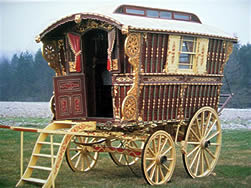
I watched a large snail traversing the patch of mown, and it brought to mind a gyspy vardo making its way down a green lane, pulled by a slow grey horse: not a bow-top I mean, but one of those big angular ones, wider at the roof than the floor. The snail moved along in something of the same way, making what speed it could before it caught the eye of a blackbird on patrol looking out for furtive lawn travellers.
If I pass during some nocturnal blackness, mothy and warm,
When the hedgehog travels furtively over the lawn,
One may say, "He strove that such innocent creatures should come to no harm,
But he could do little for them; and now he is gone."
I have always loved that description of the hedgehog travelling furtively over the lawn - it conjures up the reality perfectly for me. :0)
Today, after a day of storms and showers yesterday and a night of rain, everything is cold and fresh and wet. This morning the grass in the garden is populated with slugs and snails venturing out from underneath the sheltering plants.
I watched a large snail traversing the patch of mown, and it brought to mind a gyspy vardo making its way down a green lane, pulled by a slow grey horse: not a bow-top I mean, but one of those big angular ones, wider at the roof than the floor. The snail moved along in something of the same way, making what speed it could before it caught the eye of a blackbird on patrol looking out for furtive lawn travellers.
Monday, 6 July 2009

Sunday morning at Haddenham church Cafeplus+
When we got to Haddenham (which someone told us yesterday is/was the largest village in Europe!) we looked round vaguely for the village hall, where the Cafeplus+ is held - and quickly spotted a huge banner hung on the railings identifying it. So the first thing was that we were really impressed by the publicity that helped us find our way.
When we got inside the building, we found two big rooms, one with a stage where the presentation was to take place, one with hatches through to the kitchens. In both rooms tables and chairs were set out cafe-style, with pretty tablecloths too. In the room with the stage we also saw lots of stalls - ecological organisations like the Transition Town group and people who help you to get eco light bulbs etc. In the other room, lots of people were already having breakfast, so we went in there! :0)
The breakfast was amazing. There were different kinds of rolls, cereals, cheese, salami, marmalade, jam, different types of teas and coffees - everything you could think of. After a while a lady came round offering everyone soft white rolls with freshly cooked bacon in. This breakfast was for anyone who wanted to come, and it was all FREE! A donations box stood at the side, but no amount was suggested, required or demanded, and though the leaflet about Cafeplus+ on the table did mention the donations box, it was only in a small note near the bottom.
The people were kind and friendly, and several of them stopped by and chatted to us. Apparently St Mary's church in Haddenham has been doing Cafeplus+ once a month for four years. It runs from 9.30-12.00 on a Sunday morning, a presentation called Food4Thought following the breakfast.
In October (4th), when the church celebrates Harvest Festival, Haddenham Cafeplus+ is having a Food Festival, with cookery demonstrations, a chutney competition, local food producers, and possibly a farmers market.
As my In Celebration of Simplicity book will be just published then, and uses the metaphor of making bread as a way of looking at our spiritual journey, I asked if I might be able to have a stall and bring some books to sell, bringing along also some cookware for people who live simply - my thermos cookpot, sporks, storm kettle etc. They thought I probably could, and gave me their contact details. I think I might make a stand of pictures of the Palace Flophouse to take along for a backdrop display. The people were very open and welcoming.
After breakfast it was time for the presentation. It was very clearly done, with graphs and stories of the lives of individuals to help us understand the urgency of climate change.
We learned that the summer in 2003, which was so hot that upwards of 20,000 people in France died of the heat, will be normal in another 20 years, and a really cool summer in another 50 years, if we don't sort ourselves out and change the way we live.
We saw pictures and a film about a farmer in Malawi, called Andrew, and heard about his situation from the UK Director of Tearfund, who had met Andrew and seen his farm.
Andrew has two acres on which he grows maize, and that's all fine and he can feed his family on that, in normal circumstances. But things are changing because of climate change. He has much less rain, and then when the rain comes it is too heavy and torrential, and it is all full of sand that it leaves behind on his fields. So when Andrew plants his maize now, he has to dig down through a deep layer of sand. This means planting each plant takes him about 30 mins where it used to take 30 secs - and his harvest yield has halved.
Paul Brigham (the Tearfund man) made the point that though we would all be affected, it is the poorer people, like Andrew, who suffer first and most. He said that Andrew generates 0.1 tonnes of carbon per year, whereas most of us in England generate 9.0 tonnes at least per year - so we are causing the problems that Andrew is suffering.
He also said that in the predictions of how climate change will affect the countries of the earth, England is one of the least affected places - but that as there will be millions of climate change refugees and England is small, this is not a cause for complacency.
Paul Smith (responsible for environmental issues at Coca Cola UK) also spoke to us. He had a flow chart things showing how big companies had to pay attention to each stage in their sourcing, manufacture, distribution and supply, reducing their carbon footprint wherever possible. He brought along an old-style Coca Cola bottle and a recent one, explaining that the new one created 20% fewer emissions overall. His audience applauded him because they were polite but, after all we had just seen and heard, I suspect most like me were thinking that the most Earth-friendly thing Coca Cola could do would be to cease to exist.
Then a man from the government (James Hughes) came to speak about government things like 'targets', 'conferences', 'white papers', 'strategies' and many other burbly-burbly things of that nature. His basic message was that the government takes all this Very Seriously, is Trying Very Hard, but still Needs To Do Better. He had a large thick document with a glossy colour cover in preparation for a meeting in Copenhagen where all the government leader people gather like they did at Kyoto and talk about being responsible. It's happening soon; and he said we should all send Gordon Brown a postcard about this as it will make a difference. Or maybe it was the other man who told us to send postcards - the man from Tearfund; I can't remember.
There was to be a time for our questions, but that got mainly used up.
The questions had to be written down on tiny slips of green paper, on little close together lines. Most of the piece of paper was take up with large words at the top and space round the edge, but there were these little lines where anyone the size of a young ant could write a question.
I wrote on mine, 'I have a question but I would like to ask it myself'. Margot (the vicar) said I couldn't do that, I had to write it down. I said I couldn't do that because the question was too long. She said exactly, that was the point. So I said Okay, and never got to ask my question. I felt disappointed and frustrated, because the government man was there, and I really really wanted to ask him something. But even the ants never got their questions read out anyway, most of them, because they ran out of time. But I didn't stay to hear the ants' questions, I went outside and caught the bus back to Aylesbury because I was upset that I was never going to get to ask my question.
This was the question I wanted to ask the government man:
"At the end of the 1990s, I watched on the telly the pictures of the farmers in Kent ploughing their orchards into the ground because the EU directives stopped them from making their living that way any more. A few weeks ago I saw on telly that people stopped buying cars because of the economic downturn, but instead of seizing the opportunity to redirect money and people towards public transport, the government spent billions of pounds on keeping the factories open and trying to bribe customers to buy new cars they didn't want. At the current time on telly there is a government advert saying that if you forget to pay your car tax they can come and crush your car into a cube. How can the government do things like this, and then expect us to believe that rushing around talking about Copenhagen, strategies and white papers makes then envirionmentally responsible?'
Anyway, the government man came and went and I never got to ask my question. But he had a dinky little plastic widget the size of a credit card with a USB attachment that folded in and out of it, containing the Copenhagen document. Badger asked if he could have it and came home really pleased because the government man gave it to him. And it was a funky little thing - but I don't think he wants to read all about the government, I think he wants to take it to work and see if he can't get his publishing catalogue onto one of those instead of using glossy printed paper.
So I came home full of admiration for Haddenham church's generosity and Powers of Organisation, and determined to take the next step and the next step and the next step towards Stepping Off this awful destructive consumerist eco-vandal lifestyle of our society.
When we got inside the building, we found two big rooms, one with a stage where the presentation was to take place, one with hatches through to the kitchens. In both rooms tables and chairs were set out cafe-style, with pretty tablecloths too. In the room with the stage we also saw lots of stalls - ecological organisations like the Transition Town group and people who help you to get eco light bulbs etc. In the other room, lots of people were already having breakfast, so we went in there! :0)
The breakfast was amazing. There were different kinds of rolls, cereals, cheese, salami, marmalade, jam, different types of teas and coffees - everything you could think of. After a while a lady came round offering everyone soft white rolls with freshly cooked bacon in. This breakfast was for anyone who wanted to come, and it was all FREE! A donations box stood at the side, but no amount was suggested, required or demanded, and though the leaflet about Cafeplus+ on the table did mention the donations box, it was only in a small note near the bottom.
The people were kind and friendly, and several of them stopped by and chatted to us. Apparently St Mary's church in Haddenham has been doing Cafeplus+ once a month for four years. It runs from 9.30-12.00 on a Sunday morning, a presentation called Food4Thought following the breakfast.
In October (4th), when the church celebrates Harvest Festival, Haddenham Cafeplus+ is having a Food Festival, with cookery demonstrations, a chutney competition, local food producers, and possibly a farmers market.
As my In Celebration of Simplicity book will be just published then, and uses the metaphor of making bread as a way of looking at our spiritual journey, I asked if I might be able to have a stall and bring some books to sell, bringing along also some cookware for people who live simply - my thermos cookpot, sporks, storm kettle etc. They thought I probably could, and gave me their contact details. I think I might make a stand of pictures of the Palace Flophouse to take along for a backdrop display. The people were very open and welcoming.
After breakfast it was time for the presentation. It was very clearly done, with graphs and stories of the lives of individuals to help us understand the urgency of climate change.
We learned that the summer in 2003, which was so hot that upwards of 20,000 people in France died of the heat, will be normal in another 20 years, and a really cool summer in another 50 years, if we don't sort ourselves out and change the way we live.
We saw pictures and a film about a farmer in Malawi, called Andrew, and heard about his situation from the UK Director of Tearfund, who had met Andrew and seen his farm.
Andrew has two acres on which he grows maize, and that's all fine and he can feed his family on that, in normal circumstances. But things are changing because of climate change. He has much less rain, and then when the rain comes it is too heavy and torrential, and it is all full of sand that it leaves behind on his fields. So when Andrew plants his maize now, he has to dig down through a deep layer of sand. This means planting each plant takes him about 30 mins where it used to take 30 secs - and his harvest yield has halved.
Paul Brigham (the Tearfund man) made the point that though we would all be affected, it is the poorer people, like Andrew, who suffer first and most. He said that Andrew generates 0.1 tonnes of carbon per year, whereas most of us in England generate 9.0 tonnes at least per year - so we are causing the problems that Andrew is suffering.
He also said that in the predictions of how climate change will affect the countries of the earth, England is one of the least affected places - but that as there will be millions of climate change refugees and England is small, this is not a cause for complacency.
Paul Smith (responsible for environmental issues at Coca Cola UK) also spoke to us. He had a flow chart things showing how big companies had to pay attention to each stage in their sourcing, manufacture, distribution and supply, reducing their carbon footprint wherever possible. He brought along an old-style Coca Cola bottle and a recent one, explaining that the new one created 20% fewer emissions overall. His audience applauded him because they were polite but, after all we had just seen and heard, I suspect most like me were thinking that the most Earth-friendly thing Coca Cola could do would be to cease to exist.
Then a man from the government (James Hughes) came to speak about government things like 'targets', 'conferences', 'white papers', 'strategies' and many other burbly-burbly things of that nature. His basic message was that the government takes all this Very Seriously, is Trying Very Hard, but still Needs To Do Better. He had a large thick document with a glossy colour cover in preparation for a meeting in Copenhagen where all the government leader people gather like they did at Kyoto and talk about being responsible. It's happening soon; and he said we should all send Gordon Brown a postcard about this as it will make a difference. Or maybe it was the other man who told us to send postcards - the man from Tearfund; I can't remember.
There was to be a time for our questions, but that got mainly used up.
The questions had to be written down on tiny slips of green paper, on little close together lines. Most of the piece of paper was take up with large words at the top and space round the edge, but there were these little lines where anyone the size of a young ant could write a question.
I wrote on mine, 'I have a question but I would like to ask it myself'. Margot (the vicar) said I couldn't do that, I had to write it down. I said I couldn't do that because the question was too long. She said exactly, that was the point. So I said Okay, and never got to ask my question. I felt disappointed and frustrated, because the government man was there, and I really really wanted to ask him something. But even the ants never got their questions read out anyway, most of them, because they ran out of time. But I didn't stay to hear the ants' questions, I went outside and caught the bus back to Aylesbury because I was upset that I was never going to get to ask my question.
This was the question I wanted to ask the government man:
"At the end of the 1990s, I watched on the telly the pictures of the farmers in Kent ploughing their orchards into the ground because the EU directives stopped them from making their living that way any more. A few weeks ago I saw on telly that people stopped buying cars because of the economic downturn, but instead of seizing the opportunity to redirect money and people towards public transport, the government spent billions of pounds on keeping the factories open and trying to bribe customers to buy new cars they didn't want. At the current time on telly there is a government advert saying that if you forget to pay your car tax they can come and crush your car into a cube. How can the government do things like this, and then expect us to believe that rushing around talking about Copenhagen, strategies and white papers makes then envirionmentally responsible?'
Anyway, the government man came and went and I never got to ask my question. But he had a dinky little plastic widget the size of a credit card with a USB attachment that folded in and out of it, containing the Copenhagen document. Badger asked if he could have it and came home really pleased because the government man gave it to him. And it was a funky little thing - but I don't think he wants to read all about the government, I think he wants to take it to work and see if he can't get his publishing catalogue onto one of those instead of using glossy printed paper.
So I came home full of admiration for Haddenham church's generosity and Powers of Organisation, and determined to take the next step and the next step and the next step towards Stepping Off this awful destructive consumerist eco-vandal lifestyle of our society.
Sunday, 5 July 2009

Fab & groovy people
This morning Tony the Badger & I are going across to the village of Haddenham, where his friend Margot Hodson has become vicar, after having been chaplain at Jesus College in Oxford for some while.
Margot's husband Martin is an environmental biologist, so their sphere of thinking, influence and education makes them a grand team for enlightening folks about the urgency of climate change and the responsibility we all have to respect and love the Earth.
Margot and Martin wrote a book a few months ago, called Cherishing the Earth, which Tony the Badger published. I went with him to their book launch, and was really impressed by their data and approach.
At Haddenham, Margot has what she says is a Fresh Expression of church, called Cafeplus - I think maybe that's sometimes Cafe+ which would be a kind of visual pun about being cafe style church, wouldn't it.
I say 'what she says is' because cafe church is a fairly standard style of church now, and many people seem to be calling their projects 'Fresh Expressions of church' when what they are really is standard church with a funky twist to it. But I haven't seen what she's doing yet, so can't be sure.
Anyway, at Cafe+ in Haddenham this morning they're having a bonanza do on climate change. There will be a presentation; and Paul Brigham (UK Director of Tearfund), James Hughes (Govt Head of Carbon Budgets and Offsetting) and Paul Smith (Head of Environment or Coca Cola UK) all happen to live in the village and are coming along to be part of a panel to answer our questions.
Haddenham is forging ahead well with its Transition Town status I believe, and Margot says the local Transition group folks will be there.
So that sounds interesting, doesn't it!
At the moment I'm re-reading David Edwards excellent book Free To Be Human, which forces me to face the realities of just how un-free we have allowed ourselves to become, and makes me deeply suspicious of the input of anyone who is head of any government department at all - and the concept of 'Head of Environment for Coca-Cola' sounds hilarious in a surreal and impossible kind of way. But from the standpoint of someone who is incapable of organising groups and events in any way shape or form, I admire Margot's capacity in this regard immensely, and am looking forward to hearing what the people have to say.
The other thing I am excited about today is that I have got a bowl with one of Rima Staines ( and she's here too) fab pictures printed on. This one, to be precise. I got it from Etsy. I love Rima's clocks, but just now my purse, which is of fairytale unpredictable dimensions, is about the size of a gnat, and won't allow for such a purchase. Also, I am saving for one of these at the Herstmonceux Mediaeval Fair at the end of August. But the bowl I was able to afford :0) It came yesterday and is sitting proudly in the Palace Flophouse, a good size for picking blackcurrants or pot herbs into. Glorious.
Margot's husband Martin is an environmental biologist, so their sphere of thinking, influence and education makes them a grand team for enlightening folks about the urgency of climate change and the responsibility we all have to respect and love the Earth.
Margot and Martin wrote a book a few months ago, called Cherishing the Earth, which Tony the Badger published. I went with him to their book launch, and was really impressed by their data and approach.
At Haddenham, Margot has what she says is a Fresh Expression of church, called Cafeplus - I think maybe that's sometimes Cafe+ which would be a kind of visual pun about being cafe style church, wouldn't it.
I say 'what she says is' because cafe church is a fairly standard style of church now, and many people seem to be calling their projects 'Fresh Expressions of church' when what they are really is standard church with a funky twist to it. But I haven't seen what she's doing yet, so can't be sure.
Anyway, at Cafe+ in Haddenham this morning they're having a bonanza do on climate change. There will be a presentation; and Paul Brigham (UK Director of Tearfund), James Hughes (Govt Head of Carbon Budgets and Offsetting) and Paul Smith (Head of Environment or Coca Cola UK) all happen to live in the village and are coming along to be part of a panel to answer our questions.
Haddenham is forging ahead well with its Transition Town status I believe, and Margot says the local Transition group folks will be there.
So that sounds interesting, doesn't it!
At the moment I'm re-reading David Edwards excellent book Free To Be Human, which forces me to face the realities of just how un-free we have allowed ourselves to become, and makes me deeply suspicious of the input of anyone who is head of any government department at all - and the concept of 'Head of Environment for Coca-Cola' sounds hilarious in a surreal and impossible kind of way. But from the standpoint of someone who is incapable of organising groups and events in any way shape or form, I admire Margot's capacity in this regard immensely, and am looking forward to hearing what the people have to say.
The other thing I am excited about today is that I have got a bowl with one of Rima Staines ( and she's here too) fab pictures printed on. This one, to be precise. I got it from Etsy. I love Rima's clocks, but just now my purse, which is of fairytale unpredictable dimensions, is about the size of a gnat, and won't allow for such a purchase. Also, I am saving for one of these at the Herstmonceux Mediaeval Fair at the end of August. But the bowl I was able to afford :0) It came yesterday and is sitting proudly in the Palace Flophouse, a good size for picking blackcurrants or pot herbs into. Glorious.
Saturday, 4 July 2009

Wednesday, 1 July 2009

A deeper layer
I thought that the whole simplicity thing for me began with discovering St Francis when I was fifteen years old.
But I’ve uncovered a deeper layer I had forgotten.
When the fretting and fretting to live in a shed finally got to the point of explaining to Tony the Badger that, though I love him with all my heart and certainly want to share his company and sleep in his bed, I just have to live in a shed, and plans were made to get a second shed for the garden I knew at once that my shed was to be called The Palace Flophouse.
Now I haven’t read Cannery Row and Sweet Thursday since I was about 12 years old, so in all those years The Palace Flophouse has lain (as I thought) dormant in my imagination – but it’s obviously that that’s what's broken through to the surface. Until a week or so ago, I could have told you who wrote those books, but not a single character or happening or anything else about then. All forgotten.
When I thought of the shed as The Palace Flophouse, I felt two reservations. 1) I really dislike plagiarism and living on borrowed ideas. I would have preferred to make up a name of my own. 2) I like to call a place by a holy name – the Big House at Aylesbury is Hagia Sophia, the flat in Hastings was Gezellig, the tribe house in Hastings is Godsblessing House.
But I knew it had to be the Palace Flophouse so, intrigued, I re-read Cannery Row and Sweet Thursday, and how startled I was. Because with the top layer of my mind I had totally and utterly forgotten the content of those books, I hadn’t appreciated how formative they had been, or remembered what a resonance they had found with my soul.
The two books taken together are about the best treatise on simplicity, living simply, I ever read. I’m not sure why they don’t usually get a mention. Where Thoreau’s Walden seems to be a kind of set text (I haven’t read it all but enough to get the gist of where he’s coming from), I don’t recall ever seeing Steinbeck referenced as a simplicity guru which, in the best sense, he surely is.
Reading those books again has made something immense fall into place for me. I came to St Francis after I read those, when a certain view and understanding had already formed. The one place I part company with St Francis is over his extreme asceticism – mortification of the flesh, despising of the self. Steinbeck talks of liking yourself in the same easy way you might like anyone else, and he looks steadily at human weakness and idiosyncrasy with humour and compassion and understanding – which is surely less neurotic.
It’s not often I come across a book that makes a difference, that doesn’t leave me thinking ‘Yes, but...’ and wandering off after page 23. It’s not often either that I come across a book that can effect a healing in me, or that can create a tangible wise peace. Reading these two books forty years after I last read them has done just that.
Cannery Row. Sweet Thursday. If you know yourself called to live simply; I recommend them.
But I’ve uncovered a deeper layer I had forgotten.
When the fretting and fretting to live in a shed finally got to the point of explaining to Tony the Badger that, though I love him with all my heart and certainly want to share his company and sleep in his bed, I just have to live in a shed, and plans were made to get a second shed for the garden I knew at once that my shed was to be called The Palace Flophouse.
Now I haven’t read Cannery Row and Sweet Thursday since I was about 12 years old, so in all those years The Palace Flophouse has lain (as I thought) dormant in my imagination – but it’s obviously that that’s what's broken through to the surface. Until a week or so ago, I could have told you who wrote those books, but not a single character or happening or anything else about then. All forgotten.
When I thought of the shed as The Palace Flophouse, I felt two reservations. 1) I really dislike plagiarism and living on borrowed ideas. I would have preferred to make up a name of my own. 2) I like to call a place by a holy name – the Big House at Aylesbury is Hagia Sophia, the flat in Hastings was Gezellig, the tribe house in Hastings is Godsblessing House.
But I knew it had to be the Palace Flophouse so, intrigued, I re-read Cannery Row and Sweet Thursday, and how startled I was. Because with the top layer of my mind I had totally and utterly forgotten the content of those books, I hadn’t appreciated how formative they had been, or remembered what a resonance they had found with my soul.
The two books taken together are about the best treatise on simplicity, living simply, I ever read. I’m not sure why they don’t usually get a mention. Where Thoreau’s Walden seems to be a kind of set text (I haven’t read it all but enough to get the gist of where he’s coming from), I don’t recall ever seeing Steinbeck referenced as a simplicity guru which, in the best sense, he surely is.
Reading those books again has made something immense fall into place for me. I came to St Francis after I read those, when a certain view and understanding had already formed. The one place I part company with St Francis is over his extreme asceticism – mortification of the flesh, despising of the self. Steinbeck talks of liking yourself in the same easy way you might like anyone else, and he looks steadily at human weakness and idiosyncrasy with humour and compassion and understanding – which is surely less neurotic.
It’s not often I come across a book that makes a difference, that doesn’t leave me thinking ‘Yes, but...’ and wandering off after page 23. It’s not often either that I come across a book that can effect a healing in me, or that can create a tangible wise peace. Reading these two books forty years after I last read them has done just that.
Cannery Row. Sweet Thursday. If you know yourself called to live simply; I recommend them.
Subscribe to:
Posts (Atom)