Friday, 26 April 2019
Birds
Seagulls are anxious, jealous, nosy, competitive, greedy, cunning and persistent.
Crows are watchful, collaborative, playful, patient, intelligent and inclined to withdraw.
They are both highly observant: “Watch and learn.”
All the above characteristics mean it is a lot easier to get a close-up photo of a herring gull than a crow.
I prefer crows.
Sunday, 21 April 2019
Friday, 19 April 2019
The tree outside my window
I'm going to keep a track of this on Instagram, it's so beautiful!
The tree is an ornamental cherry that grows in my next door neighbour's garden.
In general I'd really rather sleep with my head at the other end of my bed, but I choose this way round so I can look out at the tree.
To remind you, here was the tree outside my window last November.
Then, on a day of lucid early spring sunshine in the second week of February, it looked like this.
On the eleventh of April — just a week ago — it looked like this.
We'd had some chilly days when the wind was cold, but you can see the leaves just emerging and the flower buds ready to break.
Then yesterday was really warm, so by the middle of the night above the streetlamp it looked like this.
And in the lovely light of advanced sunrise, like this.
It's a beautiful day with a slight breeze, and the blossoms have continued to unfold. By mid-morning it looked like this:
And I do believe it was even gloriouser by lunchtime.
You can sit here and watch the leaves unfurling and the blossom opening in the sun! Every time I look at it, it's even prettier.
May you always have a tree outside your window, to make your heart happy.
Wednesday, 17 April 2019
Songs of freedom
So I posted last night about sitting by the fire in the evening listening to the Clancy brothers singing, nothing changed in fifty years. And this morning I was thinking about the influences that come into our lives and the difference they make.
Unlike the Dubliners, the Clancy brothers are not so well known on the British folk scene, because they rose to fame in America. Apparently Liam and Paddy Clancy emigrated on a ship carrying them, the crew and four hundred war brides!! Tommy Makem and Bobby Clancy later came out to join them, and they knocked around being Irish and trying to make life work until the American folk music world fell in love with their songs.
And I was thinking about Julie B and her daughters, who call themselves Irish girls. That gives its name to Sharon's yarn website and her photography website too. I suppose they must be descendants of some of those settlers who came on ships from Ireland.
It's interesting, isn't it, this identity thing? Who we are and where we came from. I wondered what would happen if we got the chance for a reset and could all go back to the place of our DNA. Where would we go? I'd be back in Yorkshire, and very happy to be there. But my father's name was Stephenson, and he came from the East Riding of Yorkshire — Scarborough. There's discussion now about the origins of that name. It may be the anglicisation of Skarthaburg, from the fortress settlement of the raider Skarthi. But this has been questioned by people sceptical of the whole story of Viking settlement there, who say the name comes from the Old English meaning "hill with a fort". Whose fort, though, if not Skarthi's?
Anyway, my grandparents thought differently. They took me up onto the hills above the sea where the land slopes down to the cliffs, and showed me how it's formed into ridges with deep clefts between. And the Old Norse word Skar meant cleft, and my grandfather said that's where the name Scarborough came from. "Scarborough" means "the place with clefts in the hill".
Stephenson is a name of Norse origin. When I was a child, we had a book about Norway, with loads of colour photos showing the people and places of that country. Looking at the pictures of the fishermen was interesting because you could have put my father down among them and he would have fitted right in. And he loved Norway, and spent a lot of time there.
So maybe my deeper roots are Norwegian not just Yorkshire, and if you resettled us all I should be sent back there. I think I'd like it.
And then my thought wandered on to the influence of music in our lives, and the difference those Clancy brothers and their songs made to me.
My father travelled the world, and used to bring home with him vinyl discs of the music of places he'd been to. And at some point he brought home this EP of the Clancy brothers' songs. An EP, for those born more recently (!) was like single but a bit longer. Stood for "Extended Play", so it had 2 songs on each side, not just one, but was only the size of the discs with a single song each side. The big discs with whole albums on were called LPs (Long Players).
I loved listening to the music, which we played on a record player my father made from a converted bathroom stool with an old polo shirt of his transformed into a speaker cover and a kit for playing records built therein.
One of my favourites was that Clancy brothers record, and on that my mother's favourite was the song about Roddy McCorley, an Irish nationalist from County Antrim hanged by the British on the Bridge of Toome for his participation in the 1798 rebellion. They dismembered his body and buried it under the gallows.
I grew up during the time of the troubles in Northern Ireland during the 1960s — divided towns and British military presence and IRA freedom fighters and bombs in London and all of that. It was quite a big thing, and still is. A friend of mine still hates one of our UK politicians for going to a commemoration for IRA fighters who had been killed, and being willing to be in dialogue with Sinn Fein.
Now, my parents were (and my mother who is still alive remains so) the most politically conservative people you could imagine. True blue all the way. They weren't very interested in policies as such, their vote was Conservative; end of. Their vote was for tradition, for British values and the British way of life.
But it was my parents who introduced me to the Clancy brothers talking and singing about Roddy McCorley, his courage and anti-establishment defiance —
"There is never a one of all your dead more bravely fell in fray, than he who marches to his fate on the Bridge of Toome today;
true to the last, true to the last he treads the upward way,
as young Roddy McCorley goes to die
on the Bridge of Toome today."
That difference of perspective, and the understanding that there are two points of view about British rule, and the realisation that the country of my birth is only intermittently and partially benign, and acts with ruthless brutality and self-interest a lot of the time, started from listening to that song. It went deep into my soul as a child and had a profound effect on me — formed my thinking and my attitudes. There's power in music, and folk songs have carried the politics of the people and been the voice of the voiceless since forever.
Tuesday, 16 April 2019
Time standing still
Odd, isn't it, how things change but stay the same — the years go round and life moves on, but then there you are, just like always.
I'm nearly 62. And here I am, this evening, sitting quietly on my own in the mail light by the fire, happily listening to the Clancy brothers singing Port Lairge and Roddy McCorley and Tim Finnegan's Wake and The One Eyed Reilly — exactly as I used to fifty years ago.
Utterly content.
I'm nearly 62. And here I am, this evening, sitting quietly on my own in the mail light by the fire, happily listening to the Clancy brothers singing Port Lairge and Roddy McCorley and Tim Finnegan's Wake and The One Eyed Reilly — exactly as I used to fifty years ago.
Utterly content.
Monday, 15 April 2019
Notre Dame
Sorrow for the terrible fire at the cathedral of Notre Dame in Paris.
A place of such history and beauty. So very sad.
Competitions on the telly
In our household, we really enjoy watching the TV competitions like The Great British Bake-Off, Strictly Come Dancing, The Great Pottery Throw Down, The Arts and Crafts House, Bake Off Crème de la Crème, and several others.
Recently we watched Project Runway, and a series called Glow Up which is for make-up artists, and Buzzfloyd put us onto Zumbo's Just Desserts.
We've also seen (but stopped watching) BBC's Big Painting Challenge.
And a couple of years ago we saw — and loved — a series of Australian Masterchef. We don't like the British version.
I've been intrigued by the difference in ambience, created by the demeanour of the judges, between Australian, and the US/UK.
The Australian programmes we watched — Zumbo's Just Deserts and Australian Masterchef — were such fun, because the judges were courteous, encouraging, respectful and kind. They were candid and forthright, of course — what else would you expect from Australians? But the critiques felt like simply person-to-person assessments of the work.
By contrast, the judges in the American Project Runway, the British Glow Up, and the British Big Painting Challenge, excoriated and humiliated their contestants with the most withering and contemptuously dismissive critiques; rude, scornful and unkind. They made me think less of the judges, not the contestants.
One aspect of it that came across very forcefully was the unwillingness of the UK/US judges to hear the contestant's point of view. These judges came over all "how very dare you" at the slightest attempt by the contestant to defend him/herself. There was a strong sense of hierarchy, of the successful celebrity separated from the hopeful aspirant by a chasm that could only be bridged by approval from the judges — to gain which, grovelling gratitude was required as well as excellence. The Australians seem much more egalitarian in their culture: and in my world at least, those who show respect to others are worthy of respect from me.
One complete exception to all of this is the extraordinary and intriguing judge of Bake Off: Crème de la Crème, Cherish Finden, who came to the UK from Singapore. Direct, frank, passionate, exacting, childlike, focused, whimsical — I didn't know what to make of her at first, but grew to like her more and more. What finally won my heart was the occasion when a contestant was reduced to tears as his wonderful creation was ruined (I can't remember what happened, I think it fell over and broke) and Cherish darted across and flung her arms round him, then stepped back with a murmured "Sorry!" It made me see the gap between the persona she felt to be required of her as a judge — strict, standards of excellence, school-teacher-ish — and the person she really is. And she is the perfect foil for the urbane and oh-so-very-French Benoit Blin.
I'm not very interested in winning and losing — I don't really believe in either as a concept — but I love to watch craftsmanship and people trying their best and human interaction. That fascinates me.
Two things that really turn me off, though, are humiliation and unkindness, which is why I stopped watching the BBC's Painting Challenge — couldn't stand the cruel and acid judges.
And that's why, on Project Runway, I (along with everyone else) really like Tim Gunn, but Michael Kors with his lovingly-hatched condemnations of fellow human beings so lavishly laced with contempt, not so much.
Monday, 8 April 2019
Good Friday
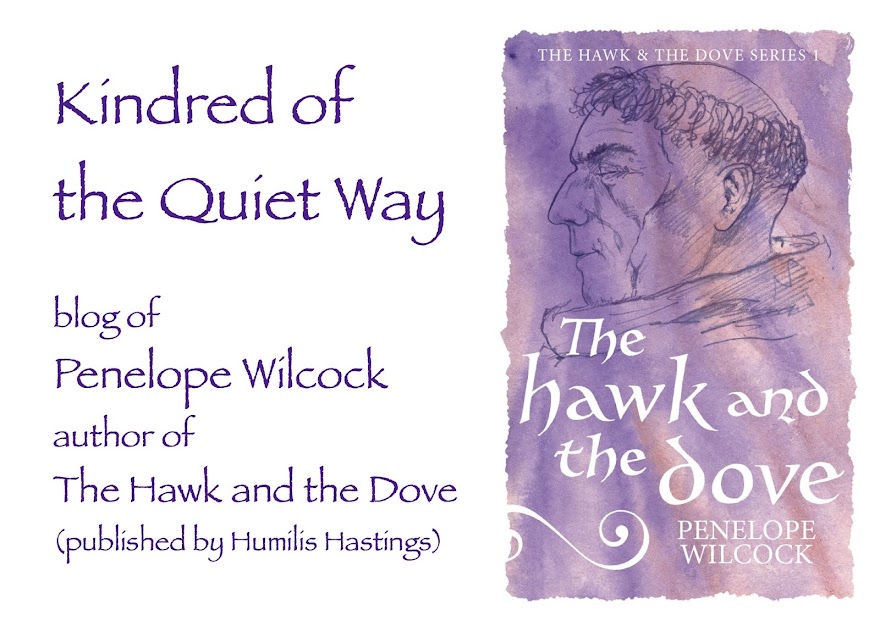
Over the course of time, I've written two books for people to read during Lent. One was The Wilderness Within You, which is about encountering Jesus in the context of everyday life, and the other is the fourth in a sequence of nine novels under the collective series title of The Hawk and the Dove. The Lent one is called The Hardest Thing To Do, and is mainly about seeing things from someone else's point of view.
It tells the story of Lent unfolding in a Yorkshire monastery one year in the fourteenth century. The community has elected a new abbot, Father John Hazell, who has a not altogether easy beginning to his new role.
There's an entry — not a chapter exactly — to each day of Lent, so that it can be read for lenten spiritual devotion. Here, for your enjoyment, is part of the Good Friday section:
THE FORTY-FIFTH DAY – Good Friday
Abbot John listened to the chapter, watched the reader return to his stall; and began to speak.
‘On Good Friday, I have nothing original to say. This seems to me not a time to be clever or innovative – to try to improve the tradition with audacious new thoughts of my own. I have no new thoughts. All my sight is filled with Christ upon the cross, nailed in stark suffering, waiting through agony for a glory he has almost lost sight of: “Eli, eli, lama sabachtani.”
‘Of all the Good Fridays I have sat in this Chapter House, keeping watch with you, my brothers, the one I remember most was five years ago. Before Father Peregrine was taken ill.
‘I remember him talking to us quietly, the way he always did. He spoke about how Jesus opened wide his arms for us on the cross; an embrace, Father said, that was big enough for everyone in the world. He said that the thing about being nailed to a cross, wide open like that, is that you are brought to a place where you can no longer change your mind. Do you remember that homily?
‘Father got a bit scholarly at this point! He spoke about the holy Name of God in the Scriptures: I Am That I Am. He drew our attention to the numerous times in the gospels – especially the gospel of John – where Jesus takes to himself that holy Name of God. I Am the Good Shepherd. I Am the Way, the Truth and the Life. I Am the Bread of Life. I Am the Light of the World. Father said, Christ was consciously aligning himself – for our benefit – upon the pattern of God’s nature and identity. He was conformed to the being of God the Father; by his choices, by his attitudes, and by who he essentially was.
‘But then, Father Abbot said that the heart of all this, the perfect living icon of God-in-Christ, becomes clear to us when we gaze upon Christ on the cross. Helpless, hurting, his arms spread wide; no longer able to even see or feel the presence of his God, no longer able to teach or choose, to challenge or heal, he is just nailed there. And his body announces the real presence of God, saying: “Here I Am”.
‘Father said, Jesus had stopped choosing for himself – he said when Christ opened wide his arms for us on the cross, that was anyone’s hug: friend, brother, enemy, betrayer – Christ was just there; it was over to us now to respond. This was the finale; the moment we decide whether we are religious sight-seers, pausing to look and then moving on – or whether we will stop, and hug him back. He reminded us, Christ is nailed to that cross. Those who jeered at him to come down from it saw no miracles. So anybody who accepts that embrace, hugs him back, has to accept the cross as well as the Christ.
‘Father said, we are the body of Christ, and we go the way of the cross. If we are drawn to him, if we are in love with him, what we do is embrace each other – without question, exception or reservation. In embracing each other, we find we have embraced the cross, but also the Christ.
‘He said; “Jesus opened wide his arms for you on the cross. It’s up to you. In each other, you have the chance to hug him back.”
‘I always remembered that. I can’t put it any better. It’s what seems to me to be true.’
Wednesday, 3 April 2019
Blog post comments and bloggers in general
If your blog is on the roll in my side bar, I read it. You may not know this, because my comments seem to vanish.
At first, I thought it was that people have to accept and post a comment manually, as I do, and haven't checked to see what comments have been left. Then I wondered if I am doing something wrong. Then I concluded I have no idea.
So, just because it's sad for you to feel ignored, here are a couple of my recent observations.
About your adventure in making wallets, Beth — I am amazed at your skills; well done! This is what I posted as a comment (but I think it may have vanished):
But my comments don't always get lost and, whether they do or not, I always enjoy reading your posts.
Lesley, I follow with breathless fascination the doings of your Aged Parent, and look out for your recommendations of books, TV and films. Somehow, my comments do get through on your blog.
Rose, I hope you're recovering from your sneezes.
Michelle, I'm waiting patiently for photos of the inside of your new home.
Bean, I love reading about your family and your home, and am always curious to know what you've been eating.
Lynda, you are my favourite next door neighbour on the other side of the world. I look up the books you recommend and I love your crocheted blankets.
Rebecca, I fell in love with that vision of blue glass. And this is Rebecca, too.
Julie B, I certainly hope you will be taking some photos at that retreat where you're speaking, and will be letting us know how it went. That retreat is THIS WEEKEND friends — please, if you have a moment, pray for Julie as she prepares and gives her addresses.
San, your stories of home education and faith-filled family life are completely absorbing and make me happy.
Elizabeth, your book reviews are so helpful and have introduced me to writers I didn't know. Ooh, look — this was a good review, wasn't it!
Buzzfloyd, I wish you wrote a blog. I am entirely sure it would be brilliant. And funny. And wise. How could it not be?
I love your blogs, friends. They are my newspaper.
At first, I thought it was that people have to accept and post a comment manually, as I do, and haven't checked to see what comments have been left. Then I wondered if I am doing something wrong. Then I concluded I have no idea.
So, just because it's sad for you to feel ignored, here are a couple of my recent observations.
About your adventure in making wallets, Beth — I am amazed at your skills; well done! This is what I posted as a comment (but I think it may have vanished):
Before I married Tony, I was widowed. My previous husband was Bernard. Before I married him, he was widowed. His previous wife was Anne. She was an artist. A big headache for Bernard was what to do with the numerous paintings Anne left behind. He made really nice frames for all of them, sold as many as he could so her work would be more widely appreciated, got some accepted in an art gallery's permanent collection, and gave some to friends who liked them. But he still had about forty left. In the end, it came to him that the important thing about Anne's work was not the painting but the making, not the 'products' but the skill and joy and creativity and delight. He realised those things could never be lost and would remain part of her life for ever. So he made a bonfire of the paintings.About your gardening efforts, Kat — I am so impressed by the determined inroads you made into your exuberant plant growth, delighted by your badger city, and I commented to say that I absolutely love your pond.
But my comments don't always get lost and, whether they do or not, I always enjoy reading your posts.
Lesley, I follow with breathless fascination the doings of your Aged Parent, and look out for your recommendations of books, TV and films. Somehow, my comments do get through on your blog.
Rose, I hope you're recovering from your sneezes.
Michelle, I'm waiting patiently for photos of the inside of your new home.
Bean, I love reading about your family and your home, and am always curious to know what you've been eating.
Lynda, you are my favourite next door neighbour on the other side of the world. I look up the books you recommend and I love your crocheted blankets.
Rebecca, I fell in love with that vision of blue glass. And this is Rebecca, too.
Julie B, I certainly hope you will be taking some photos at that retreat where you're speaking, and will be letting us know how it went. That retreat is THIS WEEKEND friends — please, if you have a moment, pray for Julie as she prepares and gives her addresses.
San, your stories of home education and faith-filled family life are completely absorbing and make me happy.
Elizabeth, your book reviews are so helpful and have introduced me to writers I didn't know. Ooh, look — this was a good review, wasn't it!
Buzzfloyd, I wish you wrote a blog. I am entirely sure it would be brilliant. And funny. And wise. How could it not be?
I love your blogs, friends. They are my newspaper.
Tuesday, 2 April 2019
God bless your day
I
is a small word
compared with You
I
is all alone until You make it two.
We is always together,
and is sometimes You and Me;
but sometimes We is more than that
when She makes three -
or even more
when He comes two
without saying who four.
And I is never lonely
when They is here with Me;
that’s I and You and He and She,
becoming Family.
And I is never really lost
when You has made I We
I has become a multitude
when They stands strong with Me.
© Penelope Wilcock 2008
"Hmm. Better when you read it aloud."
Subscribe to:
Posts (Atom)


