Wednesday, 5 December 2012


---------------------------------------------------------------------   
365 366 Day 340 – Wednesday Dec 5th
(As in, this)


I have absolutely no recollection what these things were – just, here’s proof I got rid of them!!  I must have packed them up and thought “Hey, wait!  These should have been on my 365 list!”


365 366 Day 339 – Tuesday Dec 4th


These were acrylic display stands for selling books at that book launch where hardly anyone came and even fewer people bought books – never again, it was too expensive even though it was a quite wonderful event in its way – we had some fabuloso medieval music from family and friends and it was fun.

Monday, 3 December 2012

Objectivity

I guess objectivity is something about being able to see and appreciate the nature of things – how things are.

They say about 93% of the mass of our bodies is stardust.  And well over 99% of an atom is made up of empty space.  This means, at the very least, that the nature of things is surprising and mysterious and inherently not what it seems.  So maybe I shouldn’t be surprised  when objectivity turns out to be shy and elusive.

I find the writing of Eckhart Tolle to be the most practically helpful in day-to-day living of anything I have ever come across.  Reading his work reminds me of what I really know, recalibrates my thinking, sets me back on track, and improves the quality of daily live more than I can say.  Every now and then I get stuck on something he’s written – maybe I’ve been eating it too fast and I’ve got something that needed chewing more thoroughly stuck in my throat.

Here’s an example.  I have on my bedside table his “A New Earth” inspiration cards – sound-bites from his book of the same name (A New Earth).  I don’t turn up a new card each day, because it takes me ages to think about each one.  I’ll probably be about a hundred by the time I’ve read them all.  One I’ve been thinking about for a very long time said this:

“Very unconscious people experience their own ego through its reflection in others.  When you realise that what you react to in others is also in you (and sometimes only in you) you begin to be aware of your own ego.”

If I am reading this correctly, he is saying (I’ve often heard this) that what annoys us in other people is always present in ourselves.  This is evident in families.  If a parent takes a singular dislike to one child, it’s usually true that the child in question is particularly similar to that parent.

I notice it myself in conversations.  For instance, I might be visiting with someone who talks at length about their wonderful experiences and achievements, lovingly describing what they said and did, telling me where they got this new sweater and what a bargain it was, what an interesting time they had in London last week, why their political view was influenced by how they grew up which gives them a special insight into aspects of life that no-one else can possibly know, why their particular home is exceptionally well-appointed and contrasts very favourably with the homes of all the neighbours etc etc etc.  After a while I start feeling annoyed.  Why?  Because I feel overlooked.  What about my bargain purchases, my political views, my achievements in house décor, the trips I made this week, and so forth.  In other words, I am basically uninterested in anything about the other person and am viewing the conversation simply as taking turns to show off and be admired.  I’m prepared to give the other person a go in the spotlight, but only providing it doesn’t persist for too long and I get my chance to preen and be the important one.  Oh dear, how childish, shallow and depressing. 

I can certainly detect, with no difficulty at all, the workings of the ego in my increasing sense of irritation during the course of such one-sided conversations.  If I had learned to quieten the voice of my ego, I’d be able to listen with complete tranquillity to what the other person had to say, without feeling the need to interrupt or upstage them.

But I have been puzzling over the sources of annoyance that don’t seem to fit that category.  Let me give you some examples.

My daughter takes part in a regular meeting of mothers and babies.   She sometimes takes her knitting along, to work on while they chat.  On one occasion, while she was making hot drinks for the mothers, one of them (uninvited) picked up her (my daughter’s, not her own) knitting and progressed it by several rows.  As her work included a lot of mistakes, my daughter had later to unpick the friend’s contribution to salvage the project.  On another occasion a lady observing my daughter knit took the opportunity to hold forth at some length about how much faster the work would have gone had she been doing the knitting – why, the needles would have fairly flown; she would have got along much quicker.  My daughter said nothing grumpy or rude to either lady, but she found both these interventions extremely irritating.

Second example.  Sometimes when I am at church, someone nearby – perhaps alongside or in the row behind – sings the hymns badly, sliding the notes, flattening out the syncopation, and singing so loudly as to send themselves off-key and be unable to correct it because their own volume is too great for them to hear their neighbours singing. This really annoys me.  Ruins the hymn.  I get cross.

Third example.  Years ago a friend of mine – let’s call her Joanne – had a friend who we’ll call Muriel.  Muriel invited Joanne to dinner two or three times over a period of about two months: then sent her a bill for her share of the food.  Muriel was learning to drive, and for practice needed to be accompanied by someone with a driving license.  She asked Joanne (who readily and kindly agreed) to do this for her, and the two of them spent a number of long afternoons touring the English countryside so Muriel could improve her skills as a driver.  After some weeks of this, she sent Joanne a bill for half the cost of the petrol (gas, US).  I think that behaviour is objectionable, offensive, inexcusable, and outrageous.

Now then, I do grasp that we each have our own point of view.  Even the paranoid schizophrenic’s point of view makes sense if we can look carefully enough into the whole scenario to understand their perspective (and history).  So I understand that to Muriel it seems reasonable and fair to send out those demands for payment, to my daughter’s friends it seems companionable and constructive to appropriate someone’s craft work or compare her prowess unfavourably to one’s own, and the singer in church is worshipping joyfully, doing what they’ve been taught to do – “Sing up!”

But I think they’re – objectively – wrong.   I don’t just think that I personally see it differently – in the same way that I like purple and my mother hates it – no; I think they’re wrong.   Furthermore, I can’t see how this view of mine is generated by an identical characteristic in myself; because I don’t sing loudly in church to upstage other people (most of the time!) and I wouldn’t dream of billing a dinner guest, and I would never start tinkering around with someone else’s work.  So . . . how can it always be the case that “what you react to in others is also in you (and sometimes only in you)”?

Here are some other things Eckhart Tolle says, that I think shed some light on this dilemma:

“The pain-body’s unhappiness is always clearly out of proportion to the apparent cause.  In other words, it is an overreaction.  This is how it is recognized, although not usually by the sufferer, the person possessed.  Someone with a heavy pain-body easily finds reasons for being upset, angry, hurt, sad or fearful.”

Oh.  Okay.  So maybe the pain-body not the ego is the problem here?  Maybe the subjectivity lies in the degree of reaction – maybe a reasonably objective response to the loud off-key off-tempo singer in church would be minor disappointment at the spoilt hymn, rather than the homicidal rage that seizes me?

Maybe the balanced response to Muriel’s breath-taking nerve would be musing on the possible causes for her lack of social skills and maybe amusement at her inappropriateness – rather than the white-hot indignation and outrage that I feel even though I hardly know the woman and it all happened to someone else?

Eckhart Tolle also says this (I hope he’s pleased with the publicity here and not planning a copyright lawsuit!!):

“Nothing strengthens the ego more than being right.  Being right is the identification with a mental position – a perspective, and opinion, a judgement, a story.  For you to be right, of course, you need someone else to be wrong, and so the ego loves to make wrong in order to be right.  Not only a person but also a situation can be made wrong through complaining and reactivity.”

Wisdom indeed.  But . . . this loops back round to my original perplexity; can one, then, never be actually right?  Is it only perspective that says my noisy neighbour has ruined the hymn?  Is it just as good if we all sing too loud to hold a true note or hear each other, off key and out of time?  Is it only a matter of opinion that the Vienna Boys’ Choir can do better?

Eckhart Tolle writes:

“Accepting means you allow yourself to feel whatever it is you are feeling at that moment.  It is part of the is-ness of the Now.  You can’t argue with what is.  Well, you can, but if you do, you suffer.”

Again, wise.  Really wise.  I can take from that a really helpful way forward with managing my own response.  To notice it, accept it, permit it – “no fight, no blame” as the Tao says; just allow it to be.  Not stoke it or wrestle with it.  Just let it evaporate. 

And yet – still the question comes back – is my response purely subjective?  Is it only my problem?  Doesn’t it matter how people do things – if one adheres to the traditions of courtesy and learns the skills of singing in tune and in chorus?  Or perhaps it does matter, and objectivity is about seeing that it matters but not reacting disproportionately, caring but not going ballistic?  Determination and persistence, not rage.  Holding to a course without feeling the need to launch a blistering attack on those who want to take a different way.

Eckhart Tolle says:

“Listen to people’s stories, and you’ll find they could all be entitled ‘Why I Cannot Be At Peace Now.’  The ego doesn’t know that your only opportunity for being at peace is now.”

I guess that’s the nub of it.  It’s a straight trade, isn’t it?  Surrendering one’s peace in exchange for irritation, indignation, outrage.  Is it always a choice?  I’m tempted to say “no”, but I suspect in fact the answer is “yes”.  

So with the singer in church, I could hear the discordance, and still choose peace – choose not to get involved at a visceral level.  In theory, anyway.   But, is this choosing of peace always passively accepting?  Or might choosing peace mean not getting irritated but next time sitting elsewhere in the church?   And the other situations?  How to quell the knee-jerk ‘How dare she? The nerve!!’?   I don’t know.
Eckhart Tolle writes:

“There are three ways in which the ego will treat the present moment: as a means to an end, as an obstacle, or as an enemy.”

That seems to apply helpfully.  So maybe in the church situation I might focus on what the other person came here to do (praise and worship God) rather than insisting on a perfection of musical performance.  Maybe after initially boggling at Muriel’s outrageousness I might begin to imagine how the world looks from her point of view, and learn to communicate successfully with her to achieve a better outcome (hypothetically, I mean; she wasn't my friend in the first place and I haven't seen her for decades).  Maybe I might muse on why people compare their knitting skills and want to eat off each other’s plates and meddle with each other’s handiwork – perhaps they are less ASD and more community-minded than I am?

I think if I did all these things, and engraved upon my heart all Eckhart Tolle’s advice, then without a shadow of doubt I would certainly be a better person.

Even so, that still doesn’t solve my original conundrum: what is the role and where is the place for objectivity?

Does it even exist?


---------------------------------------------------------------------------


365 366 Day 338 – Monday Dec 3rd  
(As in, this)


I loved this rosary – but though I like the idea of praying the rosary and I liked the rosary as an object, in fact when I pray I just talk to God.  And sometimes remember to listen.

 365 366 Day 337 – Saturday Dec 2nd  


Interesting book.  Interesting subject.
Tuesday, 30 October 2012

Christmas music - wot already?


My children’s father – Roger Wilcock, my first husband – is an extraordinarily gifted musician.  He can take a bunch of any old ordinary people and make a choir out of them.  He is a really good conductor, a choirmaster of excellence, and he has a most beautiful voice.

If he sits down with a couple planning a wedding, as they wonder aloud about the organ music for entry and exit, he can play almost anything they suggest with no sheet music in front of him, because he just knows it.  He can transpose effortlessly, an important skill for the beginners’ section of brass bands and church music groups.

He plays all kinds of instruments – any brass you care to name, piano and organ, violin, sitar, gamelan, electric and acoustic guitar . . . all sorts.   When he was at York University studying for his music degree, his main instruments were organ and voice.

Here he is with his sweet and dainty wife, Carol.


And here he is looking grand as president of NAMM.


And there's a picture from the Hastings Observer of him with his choir - the Hastings Big Choir - in the Observer article all about it here.

The reason I am telling you about him today is in case you like to have carols playing in the background at Christmas time.  We do.

Every year in our house we get out our CDs of his recordings of Christmas carols, and they make the festive season perfect for us.  He is the kind of musician who knows better than to try to gild the lily.  He allows the music to speak – draws it forth – lets it be what it wants to be, what it really is; and so his playing has a very satisfying, timeless quality.  When he made his recordings of Christmas music, there were two CDs – one piano and woodwind, the other piano and cello, and we have them both.  I can’t find the piano and woodwind one online – I think it might have got absorbed into this boxed set somehow – but the piano and cello tunes are available for download (see the links below).  The cello was played by his good friend Ian Gill.

Christmas, for us, is not really complete without Roger playing the carols in the background – it’s become integral.

He’s a composer too.  Though he hasn’t got round to publishing all his compositions, there are two you can get online.  One was written for someone making a Tai Chi demonstration video, to go with the movements – almost dances – of the Tai Chi exercises.  It’s called Vitality.  The other is a set of beautiful meditational pieces.  It was commissioned for a book of Celtic meditations as an accompanying CD of original music, an evocative and inspiring piece to go with each meditation.  At the time (I was still married to Roger then) I took the phone call from the publisher, who said he wanted this music but it would have to be written in a week, ready for the next publishing meeting, and could Roger do that? “Yes,” I replied without hesitation, because at the time he was just starting out as a freelance musician, and all such opportunities were seemed valuable.  He did it.  He worked FLAT OUT for a week, and managed to compose an entire CD of original – beautiful, inspiring, thoughtful – music to go with the meditation CD, in time for the deadline. Then after the publishing meeting they came back to him saying they’d changed their minds and thought they wouldn’t use his compositions after all.  They did publish it in the end, as a stand-alone set, but it was written to go with the Celtic meditations, and I think it’s a pity they got separated like that.

Anyway, I thought you might like to sample his music.  He’s here on this boxed set from Classic Fox – I don’t know the whole set, but it has his piano and cello and his piano and woodwind in, I think. 

Here's an album he's done with Classic Fox, called Advent Promise - a set of traditional Advent pieces - and this one called Approaching Christmas.  These two Advent ones have some overlap, but some different ones too (I think).

He’s here with the piano and cello Christmas carols, which are just lovely - these are the ones we play at home.  Listen to the previews - oh, it's so fab!  Take, for example, Ding Dong Merrily On High - listen to how he knows just how long to linger on each note and when to move on, so it's sprightly but not hurried; lyrical.

He has an album called Classical Christmas too - though I have no idea who the Eden Symphony Orchestra might be!  

His Tai Chi pieces are available here.

His Celtic Spirit album is on i-Tunes here.

But mainly I wanted to tell you about the Christmas music, in case you wanted to get hold of it for the peacefulness and holiness of your Advent season – okay, I know we aren’t there yet, but it’s coming!

 ---------------------------------------------------------------------   

365 366 Day 304 – Tuesday Oct 30th  


Two DVDs explaining all about the health benefits of jumping on a trampette. What more can I tell you?


365 366 Day 303 – Monday Oct 29th 


This . . . er this . . . well I think it was a plastic cradle to house some element of the gadgetry connected with our Wii Fit.  We still have the Wii, and engage in bursts of virtuous exercise that do us the world of good.  But this plastic cradle turned out to be surplus to requirements.


365 366 Day 302 – Sunday Oct 28th   


Crew-necked T-shirts.  I look awful in crew-necked T-shirts.  A lot of women do, especially if they have got a bit plump and reached the age when the bust is sliding south.  The neckline needs to kinda slide with it a little way.

365 366 Day 301 – Saturday Oct 27th   


Hmm. Two Raymond Chandlers, I think, and A Writer’s Notes On His Trade, and maybe that one with the front cover gone missing is The Witch of Blackbird Pond.  Evidently old favourites in a state of disintegration.

365 366 Day 300 – Friday Oct 26th   


A hairdryer.  To avoid complication, I try to stick with the kind of hairstyles that will just dry themselves without attention.  Every now and then if I’m going somewhere that matters in a hurry I do need the assistance of a hairdryer, but our Alice kindly lends me hers.

Thursday, 25 October 2012

Spiritual Care of Dying and Bereaved People - new edition


At the end of the 1980s I had the privilege to be part of the chaplaincy team of a hospice as the Free-Church Chaplain.  I enjoyed that work immensely, and have vivid memories of that wonderful time.

I wrote a book out of it, called Spiritual Care of Dying and Bereaved People, which was published by SPCK around 1990.  It found its way into the libraries of most hospices and a variety of seminaries and hospitals, as well as the homes of individuals looking for a lantern to shed some light on the hard path they were treading.

It eventually went out of print after about twenty years, but second-hand copies continued to fetch a good price (so I noticed when I came across it online) and every year I was approached for permission to print seminary class copies.  So it seemed like a good idea to create a revised and expanded version for republication.

In the intervening years, I had passed through a number of rich and interesting life events – including divorce from one husband and remarriage and then being widowed.  I felt these experiences yielded further insights that could usefully be written up for the encouragement of others.

The new revised and expanded version is published by BRF (Bible Reading Fellowship) and will be out in February 2013, but is available for pre-order now, from their website here. 

In the twenty years that have elapsed since the first edition came out, some things have changed significantly.  Back then, AIDS was a terrifying phenomenon  – so the chapter on that subject in the original book, pertinent then, had become out-dated, as had one or two other parts of the book.  In the new book, all that has become irrelevant has been pruned out.

The new additions are the story of the death of my husband Bernard, a section about bereavement from other forms of loss than physical death, and a chapter giving detailed and practical advice on how to plan and conduct a funeral.  In the last two decades I have officiated at hundreds of funerals.  I have majored on funerals for people whose spirituality is not easily defined or pigeonholed, but is important to them; people who are searching for an officiant who will help them honestly and authentically articulate their emotions and beliefs in a way that allows the funeral to bring something of healing and peace to a time of sorrow.

The result of all this is a useful, not too hefty volume of reflection on more than two decades worth of personal experience and pastoral involvement with dying, death and bereavement.  Sooner or later every single one of us will have to face some form of the aspect of life this book covers, so you might find it handy to tuck away on a shelf for future reference – whether for yourself or for a friend.

It is available on Amazon as well as the BRF website, but Amazon has had some kind of a brainstorm or got a gremlin in the works, with the result that it only appears on UK Amazon and the Product Review paragraph describes a completely different book.  BRF has tried to fix it but Amazon is its own planet and not an especially easy one to land on.  So for now, if you would like a copy, it's best to order from the BRF website.

 ---------------------------------------------------------------------   
365 366 Day 299 – Thursday Oct 25th  


 Oh, this was a useful thing.  A spiral tea-light holder – very compact – made a good centre-piece for a meal-table.  We have other candle-holders.  And jam jars.


365 366 Day 298 – Wednesday Oct 24th  


 Now.  One of these documents was a birthday card (from my beloved Badger I think), and the other was an instruction leaflet from some electronic gizmo.  At any given time I can reckon to have a Flotsam and Jetsam corner in my life which has exactly this kind of thing in.  An essential part of de-cluttering is tackling that very F & J corner.


365 366 Day 297 – Tuesday Oct 23rd   


Every April I go with my darling Badger to Spring Harvest.  We stay in a self-catering chalet.  Their kitchen knives are always blunt and they never have a small one for cutting veggies and we never remember to bring one from home.  Thus are surpluses generated.


365 366 Day 296 – Monday Oct 22nd   


Three years ago we put two households into one and ended up with and Embarassment of Breadboards. We gave both the kitchen knife and the breadboard to a young person starting up a home of his own who hadn't got anything for it yet.


365 366 Day 295 – Sunday Oct 21st  


A vintage nickel silver sauce ladle.  I thought it was sweet.  It was – but hey.

Saturday, 20 October 2012

Pulling it through.


If you have ever lived in a household where the residents have long hair, then you – at least one of you – will know all about the Bathplug Phenomenon. 

If you are a nice, clean person, when you get out of the bath you will not walk away leaving a frowsty rime of indeterminate stuffness adhering to the sides of the bath – especially the roundy corners nearest the plug and the plimsoll line where the top of the water sat.  Not you.  Swathing yourself in a towel, the end gripped firmly under your left armpit, your hair turbaned up in another towel, you will grab the shampoo (or bicarbonate of soda, depending on your Cleaning Persuasion, for cleanliness is next to godliness and therefore has fiercely defended denominations and hierarchies of purity) and clean the bath conscientiously as the water goes down – thus wasting no extra water, but keeping things moving so the sides don’t get scummy as the tub drains.  Gosh, that was a long sentence!  No editors here, hahaha!

And somewhere in this proceedings your eye will fall upon the plughole (not literally, friend) and there spot a thin skein of hair wound round its metal divisions.  A slender, diffident presence of hair, innocent in appearance.  Assiduous in your bathly attentions, you drop the cloth and reach down to pull it out.  It resists firmly.  You tug a little harder.  It comes loose.  There is more than you first thought.  Uh oh. 

You know what comes next?

If you pull it steadily and gently, not yanking it or breaking it, you will draw forth a boggling splendour of yuck and grot, a foot or so of grey soapslimed lumpy hairwaste, a tangling (I inadvertently type tnagling and that’s an even better description) lanyard of human hair hanging grimly but impressively onto anything else that fell down there unnoticed. 

Before you put it in the bin, you gaze at it in awe.  You display it briefly to anyone you can find to flabberghast with its hideous gnarly length.

Sometimes writing a book can be E X A C T L Y like that.  So it is right now.  I have only just finished the last one and already one editor is serving me up bright ideas for future Bumper Collections and another is mailing me a contract for a devotional series and a small clutter of editing projects I’ve promised to do is muttering in the wings, threatening the peace of my natural indolence.

So I am, as they say, running on empty.  I have to get alone with the Spirit of God, in the small hours of the night which is the only time total isolation and silence is guaranteeable in my experience, and Watch The Plughole of the empty white inner bathtub of mind, scoured clean of every clinging thought as my last project drained away.

And there, wound round the stainless steel symmetry of my discharged intellect, right there where the unseen plumbing descends on its mysterious journey into the hidden underground of my subconscious, behind the painted wainscot and below the varnished floorboards of the everyday, there I espy a slender strand, the coyly twining threads of an idea.  I reach down . . . and gently, steadily, carefully begin to pull . . .


 ---------------------------------------------------------------------   


365 366 Day 294 – Saturday Oct 20th
(if you don’t know what I’m talking about, see here) 


Mugs/cups/jug, some made by a Hastings potter, others mass-produced.  We liked them but we have so many . . .


365 366 Day 293 – Friday Oct 19th 


A musical biscuit tin that played Winter Wonderland (I know, I know – embarrassing, isn’t it) and various other bits of kitchen impedimenta.


365 366 Day 289-292  


Sunday Oct 14th – Wednesday Oct 18th
Ooh, there were some pretty things here!  I loved that jug – but it encompassed a Snag I hadn’t thought of; impossible to clean.  The speckled stoneware is made by a Cambridge potter, and I liked it a lot – but other household residents did not, and we have quite enough junk with the stuff we do all like.  The casserole was just the sweetest thing – about big enough for one (so of course we never used it).


365 366 Day 287-288 – Saturday Oct 13th – Sunday Oct 14th


A bevy of hangers.


365 366 Day 285-286 – Thursday Oct 11th – Friday Oct 12th  


Two tin plates.  One I liked, one I didn’t.  The blue and white one was a favourite, but you know, tin plates – well, everything’s fine until you want to eat hot food. Oh – assuming you are as slovenly as I am and hardly ever eat sitting on a chair at a table but mostly curled up on a bed or a sofa with the plate in your hand or perched on the side of your knee.  I am not good at sitting up straight.  I had an Alexander Teacher for a short while when I was nineteen, principally out of curiosity; she said I had the laziest back she’d ever seen.

Wednesday, 10 October 2012

Stout


For a while, when I was about twenty years old, we lived in St Mary’s vicarage in Bishophill, just near Micklegate within the city walls in York (you can just see it - red brick house attached to the church, here).  We had a garden there, walled - one of the walls was the church.  We (my children’s father – though they were not yet born – and I) had the downstairs: three large rooms, a toilet, a long passage and  a kitchen.   We used the kitchen to fetch water, but we used all our grant money for the term (we were students, I an undergraduate reading English, he a graduate student teacher) to buy a woodstove with an oven, the flue of which we fixed into the fireplace.  Best thing we ever did, because it snowed and froze and froze hard and snowed white and whirling that winter, and every time I went out I had to wear all the clothes I had and a thick Nordic shawl wound round my head and shoulders.  But because we had the woodstove we were warm as toast indoors, and even had to have the door standing open to cool us down a bit!


We had our bed in the same room, and a zinc bath to wash in; and in the corner, sectioned off by bales of hay we got from the farm out at Acaster Selby, where we’d lived in our caravan through the summer, our puppies were born.  I learned how to give birth by watching our little cross-bred bitch ride those waves and let the energy surge through her as child by child she brought those little ones through: Havoc (after the Shakespeare – “Cry havoc, and let slip the dogs of war”), Badger, Tiffany, Mary, and Harley Granville Barker II (the first was a Shakespeare critic).  I thought there were six.  Maybe I’m forgetting someone.

Anyway, they grew up in that room until we found them homes, sleeping in a box under the stove in that hard winter.  We kept Mary, and she was our family dog while our own children came to birth and grew.

When she grew old, Mary knew life was drawing to a close.  The summer she died, she savoured everything.  Every smell on every slow evening walk we had to stop for her to really appreciate, really enjoy.  I saw by how she really relished life that she would not be with us long.  We went camping in the country, and she came with us.  I never really knew a dog could have a holiday – but Mary did.  She delighted in the trees, the grass, the hedgerow, the sunshine and the open air.  She had a lovely time.  On our return we had to go elsewhere for a few days – I can’t remember where, but probably a Bible camp somewhere – and when we got back, we saw Mary was failing.  She had stayed with my children’s grandparents, and on our return we saw it was too late to move her; she was tired and old.  She stayed on a blanket in the glass lean-to on the back of their house, where the breeze could come to her over the heather that grew outside the door.  My father-in-law was with her when she died.  She had been lying quite still, unmoving for some hours.  Then she lifted her head to him, and licked his hand, wagged her tail one time, and she was gone.  Way to go, Mary.  She was a good dog.  :0)  Like Blue.

But why I am thinking of her today, is I remember as she was growing older, that she got stout, and the vet said I must put her on a diet to keep her slim.  I remember at the time thinking (but not saying, of course) “She’s not fat, she’s old!”  

I didn’t put her on a diet.  Life was happening to her, and getting stout was part of life is all.

We had a cat for a while – I’ll tell you about him too, some day, but this could go on forever, so not today!  Bart.  He was a psychic cat, and he came from nowhere to take care of us through the time our lives fell apart.  He was sent.  When he came to us he was lean and hungry.  With us he got very plump.  When I married Bernard (who was thin) and we went to live in his cottage on the edge of Flatropers Wood, Bernard thought Bart should go on a diet.  So we restricted his food.  Up until then, Bart had been a good mouser, but every mouse he caught, he brought in alive, carrying them with the utmost care to release in my tiny apartment (inconvenient).  But after he was put on a diet, Bart turned to carnage.  He killed mouse after mouse – shrews, voles, all of them.  He flung them in the air and terrified them.  I found – I shall never ever forget it – an arc of loose mouse shit along the front of our chest of drawers where the mouse had evacuated its bowels in sheer terror as Bart tortured it and killed it.  In his last act of carnage he took out an entire family of bluetits, and that upset Bernard, so Bart went back to live in the city, where he looked after my new son-in-law freshly imported from the southern states of America, and became his first English friend (apart from my daughter obviously). 

So I have observed that dieting is a mistake.  I have been on many a diet, and there is no need to add the word “yo-yo” because in my experience all diets are yo-yo diets.  Every time – every time – I take off weight (easily), feel triumphant, get new clothes, then put it all back on again with a few extra pounds to go with it.

Last year some time I lost some weight – can’t quite remember when – maybe a year or so back.  I remember I’d got quite thin around the time they killed Troy Davis, because despair seeps into my bones so easy and stays there so stubbornly when I’ve been dieting.  I exercised and ate diet food and exercised and fasted and got mighty slim.  All my flattened fat cells filled with triumph and my bones filled with despair but I was SLIM.  I told my doctor I was going to make it down to ten stones (from the original thirteen and a half.  Ha ha.) And then of course as time went by I put it all back on again.  I remember I lost loads of weight looking after Bernard when he was dying, too.  I got down to about ten and a half stones (without eating any bluetits at all), and I told him because he’d be pleased, and he said, “Well don’t go putting it all back on again!!”  But I did.

I have no idea how much I weigh now.  The bathroom scales are on Day 148 of my 365 chuck-out.   But I sense something different in my body now.  It’s getting fatter because it’s getting older.  It wants to be stout.  I take after my granny, and she was stout.  I feel well, I feel peaceful.  I am a bit astonished by the size of the cushion of fat on my belly and the circumference of my thighs, but hey. 

I try not to overeat, but I’m through with dieting.  Carbs make me feel contented.  Sweet food keeps me cheerful, and keeps the despair out of my bones.  This is not to say that I will eat unhealthy food.  Vegetables and pulses and fruit and whole grains are the way to go.  Delicious.  They should be the main thing, with everything else as an afterthought.  But I have no plans for dieting, and if my body is ageing into the form of a badger or an African bush pig, well, life is always interesting, innit?

I have no idea why I’m telling you this.  It was just passing through my mind.

Oh – if you’re bored and want something to pray for, I do so desperately need a new kick-start of inspiration to get my present book project done.  Editor waiting patiently . . .

 ---------------------------------------------------------------------   
365 366 Day 284 – Wednesday October 10th 
(if you don’t know what I’m talking about, see here) 


Blue cardigan from East.  Ooh – that was pretty.  Perhaps I should have kept it!  Never mind. It was a bit crunchy, and I do have other cardis, also blue.

365 366 Day 283 – Tuesday October 9th  


Elegant linen jacket donated into my life by my beautiful mama, who is a lot smaller than I am.

365 366 Day 282 – Monday October 8th  


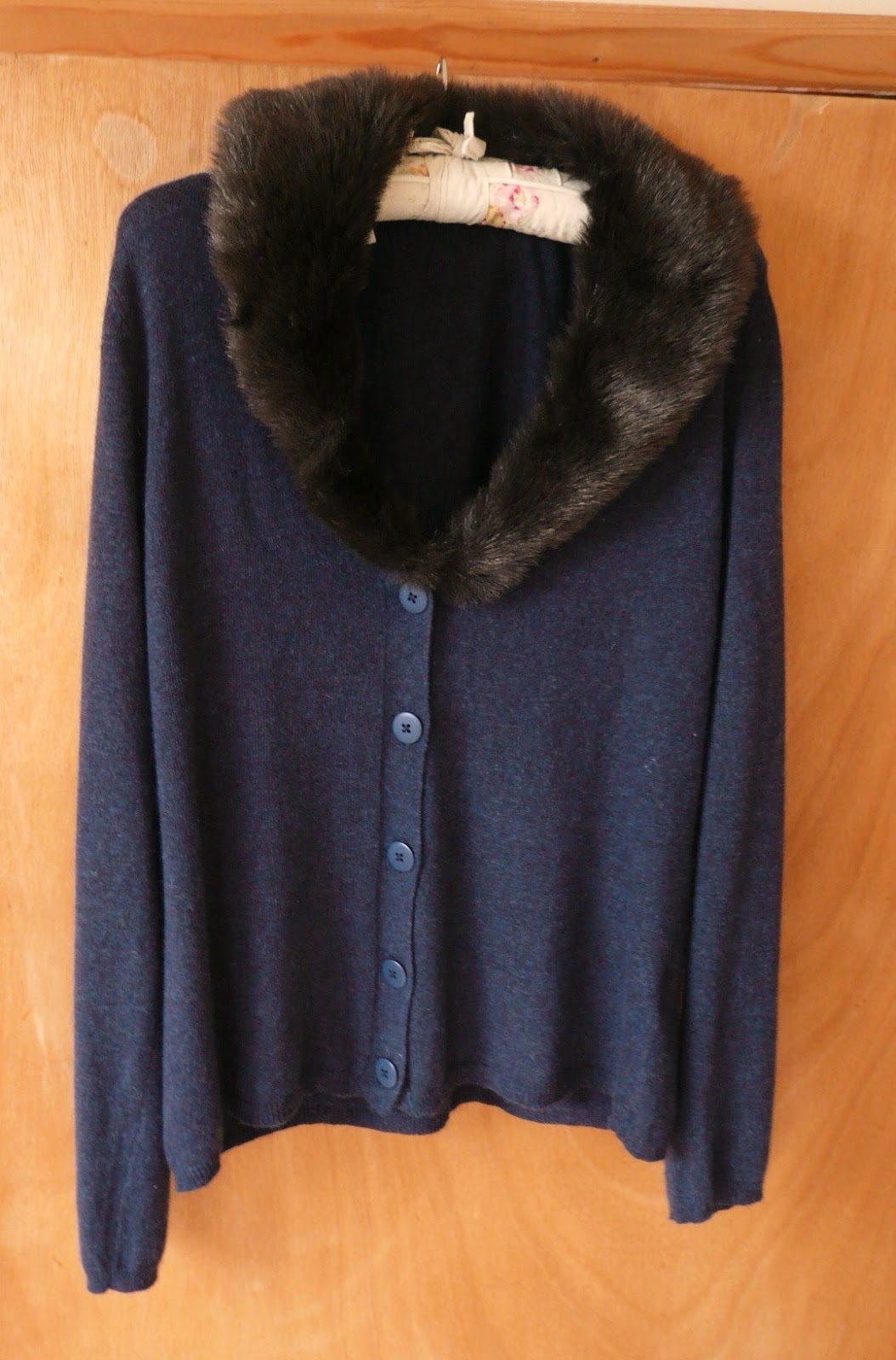
Glamorous cardi.  Soft.  Beautiful.  Furry collar.  I am not a glamorous woman, really – just sometimes in clothes shops I get bamboozled for a mo.

365 366 Day 281 – Sunday October 7th  


I usually like Rumer Godden but found this one a bit hard work.

365 366 Day 280 – Saturday October 6th  


Yet another light fitting.  This one wasn’t even straight.


365 366 Day 279 – Friday October 5th


A scarf.

365 366 Day 278 – Thursday October 4th   


Well this was a very beautiful salt crystal lamp that kinda went to the Dark Side.  It began to absorb all the damp in our old house, and left it in weepy puddles wherever it was hanging out until the effect became depressing.  Binned it.