Monday, 4 October 2021

Going home early

 My children did not enjoy school, and neither did I.

Both I and they can look back and pick out many aspects for which we were grateful — friends made, facts learned, all the usual funny moments that still make us laugh, interesting life experience, and a heightened awareness of golden September days (the autumn term started in early September after the long summer holiday) — but in general we didn't like it.

On the last day of each term, when school broke up for the holidays, the children were sent home early. This was always a day to be prized. For me, and for my children, it was such a happy thing to miss the last couple of lessons of the day and go home early.

In our household we talk about death more than most people I know, usually at the instigation of me or Hebe. I'm not entirely sure why. I was closely involved in hospice chaplaincy for several years, and with bereaved people in crafting ceremonies for funerals for many more years after that. And Hebe and I both worked as care assistants in a residential palliative care setting for some time. So our encounters with death have been up close and personal. All my daughters helped me look after my husband Bernard in the time of his dying, but it was Hebe who lived with us, in her little caravan under the spreading oak tree, and travelled with me through the long weeks and months as we saw him safely home. And we have had several other dances with death as family members ended their lives. Finding my father's body in his little cottage, the door left conveniently open. Sitting with my mother-in-law from my first marriage as she breathed her last breaths. Sitting with my father-in-law from that marriage, talking about things that mattered in his final days, singing harvest hymns in close harmony round his bedside. Spending time with my mother during the years of her long, uncertain, reluctant wandering out of this world. One way and another, it's fair to say death has been prominent in our lives.

One of the deepest bereavements for Hebe has been the loss of her beloved cat Ted — valiant ratter, ravishing eyes, a purr like a diesel engine, but also a lame leg and a heart defect. Ted was not an old cat when he died (just as we went into lockdown at the beginning of the pandemic); he was only nine. Ted went home early.

Hebe and Alice often wonder how they will manage their old age. We are not a wealthy family, and we depend heavily on sharing and helping and doing things for ourselves — we live comfortably, but that's because we also live thriftily. Of my five children, only one has (two) children of her own, and one of them has definite fragilities. "Who will look after us?" is a question that lingers in Hebe's and Alice's minds. We know that those five sisters will always be there for one another — but I remember the loneliness of my great-grandmother, once her sisters had gone home ahead of her, and she was the only one left. What then? 

So death and dying is a topic of conversation that comes round for us fairly often. We are intensely interested in the world of light — I have glimpsed it, I can remember it — and in the pathways of the soul that thread their way between this world and the world of light that carries it, surrounds it, over-shines it. We are interested in the light beings who watch over us and help us. We walk along the highway bridging the gap between Earth and Heaven that Jesus opened for us. We look for the signs along the way. We notice the changing landscape as we pass through.

And, in these strange and sorrowful times when so many have died — and the pandemic is only one part of it, there's more to it than that — Hebe has come up with a phrase for the ones (like her Ted) who go before we thought we were ready to say goodbye. She says they got to go home early. 

All of us come here to learn, and to teach, and to make friends and travel along together. Living on Earth is a lot like going to school. 

There are times and seasons – term-times and holidays, hard and hated lessons, and ones we look forward to, with teachers we love and admire and some seriously horrible ones too — but all of us graduate in the end. 

There is leaving home to go to school in the morning, dressed in our strange uniform of skin and bone; there is the experience of meeting the rest of our year group, and searching for friendly faces; there is the awkwardness of playtime and the tensions of finding a partner to go into assembly with us, hand in hand. But the sun begins to sink towards the west, and at last it's home time. And if it's a special day, if you are lucky — perhaps if you have been ill — someone will come to collect you, and you will get to go home early.

Sunday, 3 October 2021

Tracks through the forest

 There you are, wandering along, doing nothing in particular, no plan — and then suddenly life picks you up and takes you somewhere unexpected and completely surprising.

In March 2020 when the virus struck, what came to mind first was that people would need accessible online spiritual support. I was so fortunate to have participated in St Pixels online church, and I could see how a Facebook group could be adapted to create something similar.

Most of the worship that emerged online at the beginning of the pandemic (things broadened out as time went on and people got au fait with Zoom) was definitely a spectator sport. Priests essentially posted videos of themselves enacting liturgy, or (in the more house-church end of the spectrum) church music bands posted videos of themselves performing a song, or children's leader put up videos of action songs, or churches posted podcasts and videos of acts of worship (hymns, prayers, bible readings, sermon).

What particularly interested me was the understanding this implied about what happens at an act of worship — what it is.

For my family, a crucial aspect of going to church is the conversation in the pew. Our pew always has an ongoing sotto voce commentary about whatever is happening, augmented by exchanged glances and understood facial expressions. We have all been going to church so long that we have a massive shared memory bank of (mainly hilarious) experiences undergone together.

So, as soon as the hymn "Lo, he comes with clouds descending" is announced on Advent Sunday, everyone in our pew knows this hymn has the "dazzling body bears" in it — second cousins to Gladly the cross-eyed bear, and the cross wee flea, and the image bear, a menagerie found in hymnody and treasured forever. We sing the hymn, we don't say anything, but the person next to you will quietly nudge you with her elbow when that line approaches, or silently point to it on the page.

Church isn't church without this sub-culture of incessant interaction. So when the UK went into lockdown and chapels closed, I knew this was an aspect of attending church that absolutely had to be incorporated in new online forms.

And you can do it on Facebook.

When we created The Campfire Church, we'd set up an event for Sunday morning — just a designated page on Facebook — that only members could access (to protect privacy and discretion in intercessions and confession etc), and where only hosts could post.

So the posts on the page were like the people who stand at the front in church — the reader, the preacher, the intercession-leader. Some were text based, with an picture to add a visual and imaginative dimension, and some were links out to YouTube videos (for the reading, the sermon, sometimes a different form of prayer). But the comments for each posts enabled full participation.

Our intercessions were always a time of open prayer; the host kicked off with a written starter prayer supported by an appropriate photo, then in the comments section anyone who wanted posted their prayers.

And because of the emoticon reaction function on Facebook, it was possible to feel the affirmation of others in prayer with you — or sometimes others would reply to your prayer specifically with an "Amen" or similar.

And on the posts with the sermons, it worked exactly like church does — as they watched the video of the sermon, people made observations in the comment section of the post — saying if something especially spoke to them, or adding thoughts of their own.

Likewise in the hymns — in the comment section someone might remark on something uplifting or amusing in the video. It was just like being together in church.

Gradually, as vaccinations were rolled out, the churches began to open up once more, and it was possible for everyone to go back to where they were before. Except not everybody wanted to. The pandemic season had exposed and amplified dynamics we had striven to overlook and ignore; and the natural break of lockdown just (for some of us)  . . . extended.

Once it became possible for people to return to their churches, we suspended The Campfire Church — we didn't want to set up a rival organisation. But it became apparent that some of us didn't want to go back, couldn't find a place to settle; we had changed, and also perhaps been obliged to face up to some aspects of our experience of church we'd been trying not to see.

I and Grace (Buzzfloyd here — my daughter) began to look at ways forward for the stragglers; the people who didn't want to go back but couldn't find a way forward. We believe quite strongly in physical meeting, though we aren't over-smitten with institutions, and in the end we've settled on a physical (in the house where I live) meeting on the second Sunday morning of each month. We're calling it the Second Sunday Circle. Whenever there's a fifth Sunday in the month, we'll go back online for The Campfire Church to meet again, on Facebook.

It's been a while since I bore responsibility for a physical church group, and online it's all pictures and videos, ideas and words. 

Our Second Sunday Circle needed resourcing, in the same way as did The Universal Glue Factory, a fresh expression of church I ran about 20 years ago (the glue that holds the universe together is love, btw), and the retreats and quiet days I used to run.

So I set to, putting together the stationery and art/craft/music resources we'll need, as well as seating, coffee mugs, etc.

During the 20 years since the Universal Glue Factory ended (because I got married and moved away), I've lived in shared homes where my personal space was very restricted, so my possessions have been limited to clothes and toiletries and medications, pretty much.

I have been startled to discover such joy, such a sense of play, in getting together the materials for creative expression. It's such fun to come up with ideas, to make things and share ideas.

My idea of church is not about sitting in serried ranks listening, and reading prayers out of a book. My understanding of church is cauldron magic (the nourishment of a sharing circle), not sword magic (top-down authority where one person stands at the front and everyone else sits in rows to watch and listen). 

Some people express their souls best in music, others in prayer and healing, others in words, others in pictures. There should be possibility and entry-points for every different kind of person, and something for even the smallest child to relate to.

And hot drinks and snacks. Grace made the point (talking about cafĂ© church) that when you go to a friend's house they make you a cup of tea, and it's the signal to sit down together and chat. So when you go to meet up with Jesus and his friends, it makes sense to be offered a hot drink and a snack, and get out your knitting, and sit down together to interact. Our Second Sunday Circle will be that kind of church — with songs and stories and conversation, the sharing of who we really are.

But, when I said at the beginning, "there you are, wandering along, doing nothing in particular, no plan — and then suddenly life picks you up and takes you somewhere unexpected and completely surprising", I was thinking about how surprised I've felt at my own response of excitement and joy at the thought of being allowed to play again — being allowed to have the craft materials, and join in singing, and meet together to share. Oh, my goodness, it's going to be brilliant!


Tuesday, 28 September 2021

Winners and Losers

Because of algorithms (I suppose) all kinds of intriguing advertisements for things that interest me waft across my newsfeed on Facebook.

Today, this.


I try to keep someone always on duty atop my inner watchtower, and that perpetual watchful eye reported misery trailing in the wake of that advertisement. So I stopped and enquired within. Why?

It was that bit at the top making me feel cast down: "You . . . can learn from the world's best . . ."

Now, of course, that is an exciting opportunity. Margaret Attwood is a celebrated writer indeed, and celebrities are typically difficult to get close to.

The outfit posting news of the workshop is called "Masterclass".

In a sense, they had posted an advertisement saying: 

And, to be fair, I suppose anyone willing to shell out their cash to go on a writing workshop with Margaret Attwood must have the humility to accept that in any case.

But, what is celebrity anyway? I think of JK Rowling's spectacular success arising from her Harry Potter series. Of those books, I enjoyed Volume 1, Volume 2 a little less, Volume 3 even less, and I got bored and wandered off halfway through Volume 4. There were so many holes in the world view it proposed, and so much of the contract between writer and reader was broken. 

By contrast, Susan Cooper's series The Dark Is Rising is, in my opinion, stunning. She is well-known as a writer, of course, and some of her work has been adapted for TV — but she's twice the writer JK Rowling is and half as celebrated.

I have the same reservation with competition programmes. I love The Great British Bake-Off, and Strictly Come Dancing, except for my sadness that the whole purpose of a competition is to create losers. Yes, a competition creates one winner, but to every winner there are as many losers as there were other people in the competition. And that, by definition, in my opinion, makes the competition a failure. 

Because nobody wants to be a loser. And some of those who lose, do so undeservedly. Sometimes those who win caught the judge's eye for more complex reasons than talent and ability — judges are only people after all. Like the violin teacher who was one of the judges in the music section of our Methodist District Festival one year. Our Rosie entered, playing her trombone. I think she may have been about thirteen. She didn't win, which was not of itself a problem to us (I mean, who cares?) but what I did object to was the violinist judge kindly explaining to her that the girl who won (a violinist) probably had the edge over her because a violin is a more inherently musical instrument than a trombone. Say what?

I was in a competition once, at the age of eight. It took place within another child's birthday party. We were asked to go in fancy dress. A neighbour's small child (perhaps five years old) had chicken pox, and as a consolation for missing the party, was given the opportunity to judge the fancy dress parade. We all filed past the front window of the afflicted child's house, and she was to pick the best costume. I went as Little Bo Peep. My get-up was okay, but nothing special. But, my mother had somewhat narcissistic tendencies, and to survive in life it was important to understand how to charm her. Learning this skill conferred certain advantages. I learned from an early age how to flatter people, and how to make them feel special. We all filed past the child's house, and as we did so I turned and waved to the little girl and smiled at her. I knew I'd win (and I did) — even though my costume wasn't the best.

Once, I was given the opportunity to be both entrant and judge. It happened in the course of my ordination training. All sorts of psychological game-playing happened there, and on one occasion the person who had come to run the seminar began (this was usual) with an "icebreaker". Our class was instructed to form ourselves into a line — with the most attractive at the top and the least attractive at the end. I mean, what were they even thinking of?

The ordinands began to move, in varying degrees of uncertainty, most congregating about two thirds of the way down the line. Only I and my friend Giles responded to this toxic nonsense with the same idea — we both rushed to the very top of the line and stood there together. I see myself as no great beauty (and his evaluation of himself was probably quietly realistic), but I was not going to be shamed by that kind of crap.

So, although Margaret Attwood leaves me standing when it comes to literary success, and she is both celebrated and revered, I still won't even consider attending her masterclass. I know — I might enjoy it, I might learn loads, it could be really interesting. 

It's just that there is this stubborn, irrational voice of hope inside me, insisting that "the world's best" is not a position already determined and taken.

It's not Margaret Attwood I have a problem with — it's the advert.

Saturday, 25 September 2021

Sometimes not always

 I can be a little slow.

I have always been a black-and-white, 100% kind of person. Take food, for instance. I am utterly useless at those kind of diets where you go easy on sugar, where you don't go mad with the bread, where you just eat a little of something. I'm always like, "Are we eating this or not?"

In my endeavours to do pretty much anything, I tend to see the results in terms of success or failure — I can do this, but I'm no good at that. If I don't succeed, I give up. If I can't go all the way with one of my ecological aspirations, I think half measures won't do.

In the last year or so when I've had health problems, I've given up doing more and more things until life has become distinctly limited — naturally this was accelerated and intensified by actual lockdown!

But I realised today (this is what I mean, I can be a little slow) that it's not necessary to categorise everything as Things I Can Do and Things I Can No Longer Do. There's another, much larger category of things I might be able to do, let's see how I feel today. 

Last night I was so tired and everything hurt so much that I went to bed early with the thought that I'd have to cancel plans for today — a visit I've been looking forward to. But then I thought, well, the day before yesterday I managed all the man-handling of badger-defeating stones at the garden centre, so maybe today will be like that day. 

I also decided to re-categorise how I feel as "have been unwell" instead of "growing old" — because after all, you see lots of old people nipping about like mountain goats achieving all kinds of things.

Perhaps this is one more aspect of living in the Now that I need to learn — seeing what today brings, and being present to its possibilities.

Friday, 24 September 2021

Engawa

We have an engawa and we didn't even know it.

Japanese life and culture speaks to my soul, and I enjoy watching YouTube videos on that very subject, and recently I settled down to one all about traditional Japanese homes.

I discovered that they typically have what is called an 'engawa' — which is a small courtyard with moss or low-growing plants, a brazier to make a cup of tea or something outside, a cherry tree, and a spiritual statue.

And I thought — oh, my goodness — that's exactly what we have!

Our house, like most Victorian homes, is L-shaped, creating a little courtyard. There we have our water butts and our wood store — but also a buddha under a small flowering cherry tree, and a patch that used to be for growing vegetables but (after our plot beans blew down in the storm and our potatoes and tomatoes grew so huge and jungly that it was impossible to edge round the patch) then a year ago I planted it with lawn camomile and lawn mint and low-growing thyme and mossy plants. The plants established beautifully, and it looked so pretty. 

Here's the buddha from our engawa, in the spring, under his flowering cherry.


I wanted a Jizo statue like the one they have in the moss garden at the Sanzen-in temple in Kyoto.


Jizo, meaning "womb of the earth", or "earth bearer", represent Jizo Bosatsu, a Japanese guardian deity going right back to pre-Buddhist days — for the protection of children and travellers. They are always made of stone, the material that represents the Earth, and are often placed as memorials for children who have died or are stillborn. They are always in the form of a monk in simple robes, a bodhisattva whose vow is not to leave Earth for Nirvana until all the hells are empty. Rather like the archangel Rafael who travels with us, our companion on the journey and our divine protector.

Here is the one I put in our engawa.


Lovely, eh?


But, can you see little holes among the plants? Badgers did that, digging for worms. 

They came back. Night after night.


They trashed the plants. They dug holes everywhere.


I replanted everything, but they came back, every night, digging for beetles and worms.

They trashed it absolutely and completely, digging up the little stones and tossing the plants everywhere.


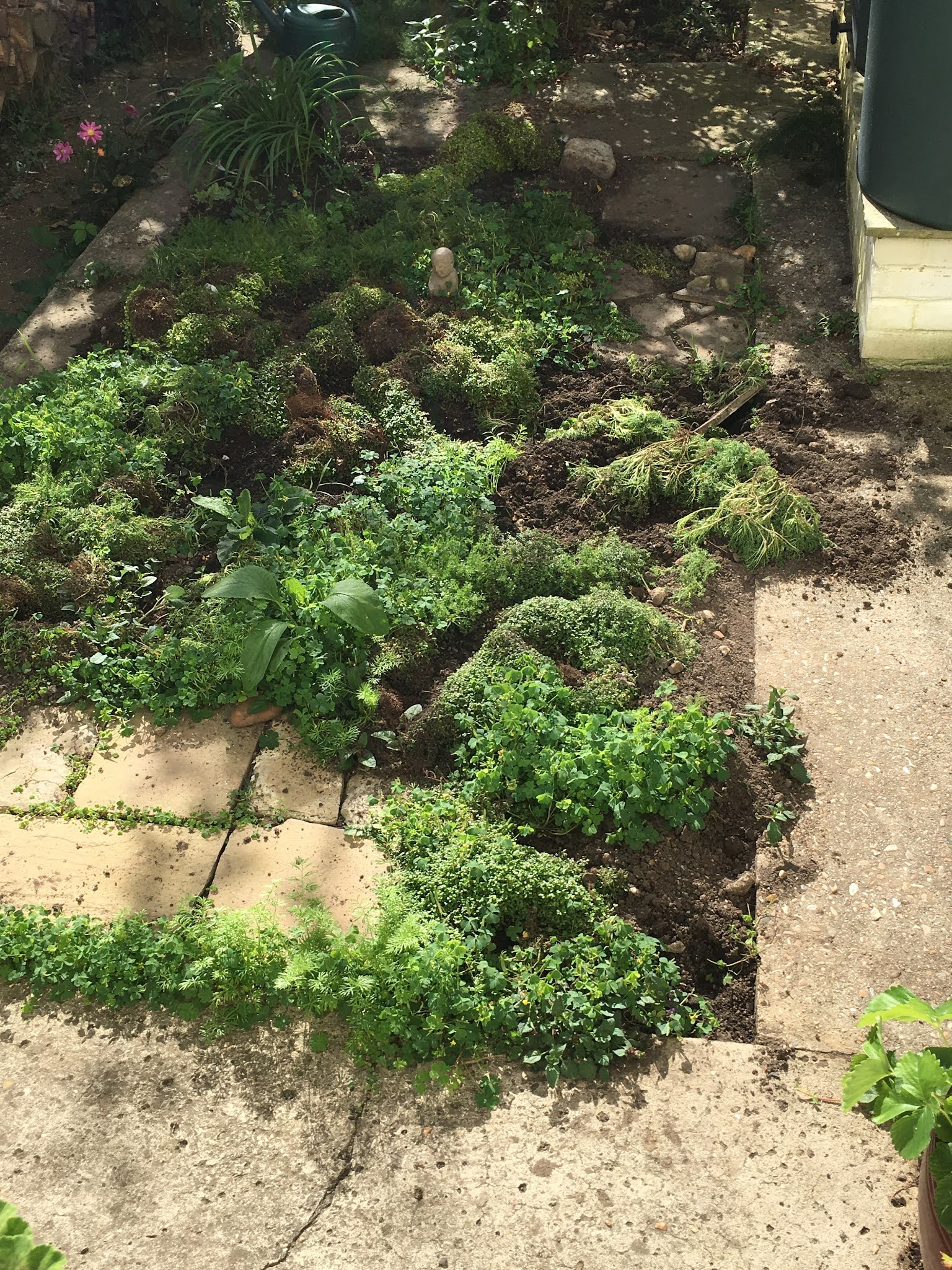
So we got more, bigger, stones. Today we (Alice and Hebe mainly) put them in. This is what it looks like now.


I think I'll wait and see what the morning brings before I put the Jizo statue back, because I don't want it to get broken.


Thursday, 23 September 2021

Crow call

 I have several shirts, and most of them don't need ironing because they're made of polyester-cotton. If I don't spin them too hard (or if I hand-wash them) and hang them carefully on the line, and fold them just as carefully when I bring them in at the end of the day, they can go straight back on the shelf ready to wear.

But my two favourite shirts are made one of cotton lawn and the other of fine linen. The cotton one is blue with a lovely pattern of massed flowers, reminiscent of William Morris's designs. The linen one is white and has pin tucks, narrow cotton lace and mother of pearl buttons.


Because they are all natural fibre, they do need ironing.

The consequence of that is I wear them quite infrequently, because they spend most of their time sitting on the top shelf of my bookcase, waiting for me to remember to iron them. I mean to, and then I put on one of my polyester-cotton shirts when I get dressed, and then because I am now dressed I forget all about them, and there they stay.

But today I determined I would get those shirts ironed, and I took them down to the kitchen, and first made myself a cup of coffee and sat drinking it outside in the sunshine on the decking by the studio door.

Then my attention was caught by next door's deadly creeper sneaking its horrid little hands through their fence. It is a beautiful plant, to be sure — a Passion flower — and the bees love it, but I don't. It stretches out until it covers the distance to one of our shrubs or trees and there it winds around and around whatever it can reach, binding itself tight to the branches, dragging them down, using them as a ladder to extend its horrendous ambitions to make a kingdom that will eventually swamp the whole earth. So every time I see one of its ghastly little fingers stretching through the fence, I break it off. It also throws its seed pods into our garden and tries to take over the world that way, and I keep vigilance over the area near the wall and pull them out when they sprout.

So I reached across from the deck, but the sneaky waving feeler was just out of my reach. I went down the steps and round to the wall where I could get at it, and this attracted my attention to the nettles growing back around the cherry tree. I tip out coffee grounds and washing up water down by that tree, so the nettles flourish there as well as the tree itself. So I went back indoors to borrow Hebe's gardening glove, and I pulled the nettles out.

While I was doing this, I heard a really strange bird call — like a quietish football rattle ending on a chuckling musical note. I've heard it before. Whatever is that bird, I thought, and straightened up to look. And there, on the chimney-top of the neighbours the other side, stood this year's teenage crow.

I realised what had happened. A few years back, when I first began to make friends with the crows, I bought a crow call — a thing you blow into in such a way that it mimics the call of a crow. You have to do it properly; if you don't, it just sounds like a party tooter.

But people use these things to lure crows with intent to shoot and kill them, so I was actually quite keen not to teach our crows to trust the sound of one of these devices used properly. I just used it badly, so it would sound like a party tooter but I could still call the crows. It was highly successful, and I came upon a whole posse of the crow family high in a Scots pine in the park, talking to each other about it and trying out the sound it makes.

All of them would stop in mid-flight to give us a shout out in a special party tooter voice if they saw us out and about walking the streets of our neighbourhood (which is also their neighbourhood).

That year's baby was a very chatty bird, and would often spend twenty minutes at a time conversing back and forth with me. He was an unusual bird with tatty feathers and a very long, thin, curving beak — somewhat clumsy but a very articulate bird who could say lots of different things. His parents had already taught me how to make a 'chuck' sound like a jackdaw to announce my presence and indicate that 'this is food', but that bird also taught me a word to say that lets all corvids know I'm a friend — a sort of tongue-rolling rattle. After he showed me to do that I stopped using the crow call because I could just make the sound with my tongue, and it's worked well for calling crows through the two years since he taught me to do it.

But this year's baby — also a very friendly and chatty bird — had evidently listened carefully to me doing this sound, and what he was saying from the chimney this morning was his best approximation of it.

The advantage of this system is that it allows him to announce his individual presence — 'I'm not just any crow, look, I know the password.'

So I called back to him, and went indoors to get him some more minced beef, even though Alice had already given them their breakfast.

He is still only at a learning stage — finds it hard to land in high wind, drops a lot of food everywhere, hasn't got the hang of stacking meat in his beak or storing it in his crop, is very scared to come down and get his food and stays so long in the tree gathering his courage that the seagulls get in first — so his parents have to help him out a lot still. I think they find him a bit of a nuisance — they detail him off to sit in the tall ash tree as the lookout bird, while they clear off to the park for some peace.

I went back indoors to iron my shirts, but if I tiptoed into the studio and stood by the freezer, I could see in the sunshine outside the shadow of crows sitting on the deck rail enjoying the meat I'd put out for them on the newel posts, which make handy bird tables.

Actually, those birds did very well today, because our cat Miguel also caught a rat this morning, and the crow family always sends someone by to pick up any rodent corpses we have to offer.

It's a happy relationship.

Tuesday, 21 September 2021

A window. And breathe.

Everyone is online nowadays, but still there are people for whom it's a lifeline.

Back in 2006, emerging from a whirlpool of stress and trauma with one disaster after another, I married Tony, left my work and moved right away from my family, to settle near his work in a place where I knew exactly no one. As it turned out, the whole nightmare was only half through, because we had all manner of family ghastliness to live through, stretching on for years. 

I hadn't quite reached the place of autistic burnout I arrived at later, but I was in a semi-sleep-walking condition, and trying to figure out how to make life work with everything I was trying to process, all the sturm und drang still going down, and suddenly no job and no friends. Blimey. What a time that was. 

I enquired within, what on earth was I supposed to do now; and the answer came back very clearly, "Look at the blue." 

I had no idea what that meant, so I tried putting it into practice in every way I could think of — blue skies, blue flowers, blue clothes; wherever there was blue, I let my eyes rest on it to find its healing power.

Then I found my way to social media. At that time I hadn't heard of Facebook, but I did find my way to a place called Zaadz — "a community of inspired people dedicated to changing the world". There I was captivated by virtual reality; how you could have an online place you could wander in, just as you would in a town or village. 

Not long after that I discovered the online church of St Pixels, where I made several friendships that still abide to this day. At St Pixels I learned to blog, experienced participatory online worship, and found people of faith joining hands all around the world.

I remember in particular realising how many people were online because they were struggling. Kind, vivid, clever, funny, dear people — but there because they were kept indoors by ME, or housebound because they were caring for someone else, or living with chronic illness or depression or neuro-divergent conditions, or living through trauma from divorce or redundancy. The online world was full of those who were quietly struggling but consistently and bravely there for one another.

I learned that this was a place where people would come online at two in the morning because they couldn't sleep, to see if anyone else was up to keep them company; and sometimes I'd come across someone in London sitting and chatting with someone in Queensland.

At the same time, I began to attend Quaker meeting, and gradually made friends with Friends, and discovered the wonder of communal silence — how silence was like a lake or a sea, and we swam through it to emerge on the other side different because we had made the journey.

So, trudging through a stony and thorny landscape, lit with flashes of joy — not least, a new marriage — I made common cause with others who were struggling too; but I also began to unravel. And in truth I never found my way back again. It all went on too long and went down too deep.

And then last year I was ill, and somewhat heartbroken by yet another series of difficult events. Eventually I came to a place where physical pain was unrelenting and my soul just clenched into a spasm.

But, there is something I discovered years ago (I've had several goes round with significant depression, and had to learn how to manage it), which I still find to be true — there are windows; and you have to take a moment to breathe.

What I mean by windows, is that there are moments you can seize to lift you out of impossibility to possibility. When everything is dark, a chink of light opens up and you head there. You may be stuck, or exhausted, or in despair; but then there suddenly comes a moment when you are capable of making a phone call, or going outside; a day when you can dance, or you want to sing, or you find the courage to meet up with a friend. At times when you simply can't, have patience, wait and watch — and then when the chance comes and the window opens, fly through it; take the chance. Gradually you can strengthen your soul that way; you can optimise hope and faith and positivity.

And for taking a moment to breathe, I mean that when you are tired and knocked back, just sit down quietly for five minutes and give yourself space to re-group. At the present time, I have set myself the goal of at least walking round the block every day. This afternoon, I wanted to walk along to the grocery store to buy a cabbage and some onions, but I just couldn't summon the energy. So instead of forcing it, or giving up on it, I gave myself a moment to breathe. I sat down and read a story, which lifted my imagination, and at the end of it I was ready to go for a walk, so I went out for the cabbage and the onions, and I didn't walk too fast and it was okay.

I don't normally promote my writing on this blog, but I want you to know that you can use my books — particularly my fiction — to help in this kind of endeavour. Several of my books are written in short sections (perhaps especially this one and this one and this one and this one and this one), just bite-sized chunks so that if you are tired and stressed and cannot concentrate very well, or if you need somewhere to take refuge and something outside yourself to lean on, to help you gather yourself and try again, you might find it here. And they are written to lift you up, to give you hope, to help you get up and keep going. As the well-known Lavinia Byrne used the opportunity of a review, for The Church Times, to say of my Into the Heart of Advent: 

"There will, of course, be a readership among those seeking comfort rather than the challenge of too much reality. A Covid-19-free read: consoling, probably; relevant, not." 

Oh. Rats. It was written before the pandemic, though published within it (hence being Covid-19-free). Well, if you can cope with my unreality and irrelevance, and if you are part of that large online readership desperately in need of comfort, perhaps you will find it. If your heart is broken, perhaps it may console you, and help you put one foot in front of another for one more day.

It's also the case that if you write a comment on my blog, it doesn't automatically publish, it comes through to my email first. So if you need to yelp for help, you can write to me in a comment giving me your email address, and we can talk privately by email. 

If you are struggling, if it is all too much, give yourself a moment to breathe, and then try again — gently. If it is all dark, and you are lost and frightened and can't see any way ahead, sit quietly with it and ask God for help, and wait for a window of possibility to appear; and when it does, don't hesitate, take the chance.

And if all this resonates for you — well, God bless you; may you be strengthened, may you be peaceful, may you be free. xx


Monday, 20 September 2021

Oh, for goodness sake

 I am an absolute shocker at spilling food. I see other women are, too. You have to have an eagle eye to examine in close detail the photos of secondhand tops for sale on eBay, because so many of them have little telltale stains on the front where someone's salad dressing has dripped.

Some eBay vendors are really quite brazen about this — they have the nerve to ask you £23 (or some such unreasonable sum) for a garment that only cost about £30 in the first place, belonged to an old lady, and now has a mini-waterfall of ex-lunch decorating the centre front. 

But last night I really did excel myself. In the evenings, in appropriate seclusion from the rest of the household, Tony watches TV programmes like Wheeler Dealers (where they do up wrecked cars and sell them on) and sport, and Dragon's Den (marketing burns as a Perpetual Light in the sanctum of his soul). Meanwhile, in the adjacent room, the female contingent of the household watches the property programmes — Homes Under The Hammer, A Place In The Sun, Escape To The Country (we would like that) — and programmes about forensic detective cases, animal rescue, border force work, and helicopter ambulances. 

Yesterday I made myself a plate of supper (pizza and salad) and sat down in my nook to watch a really interesting programme about the work of the emergency ambulance service in north-west England during the height of the pandemic. Oh, the pressure on those poor paramedics during those scary months! Part of the programme was filmed at the time of Storm Christopher, when the river Mersey flooded, so not only were the emergency services inundated with calls from panicky people who had tested positive for Covid, sent home to isolate, and now couldn't breathe or were going into cardiac arrest, but when the ambulance tried to reach them the roads were flooded. And then when they got them to Accident and Emergency, the hospitals were full and they just had to sit outside with the sick person in the ambulance while high-priority calls stacked up at the central switchboard. They were so patient and cheerful and brave. And a five-year-old child rang in, alone at home with her mother who had collapsed. And they were called out to a homeless man who had Covid, and none of his friends or relatives would let him come and stay with them, and none of the hostels, because everyone was too frightened of catching the virus. So he sat outside on the street in the freezing rain of the storm, with nowhere to go.

It was a riveting programme.

But right at the beginning of it, I sat down with my plate of supper, and the first thing I ate was a small beetroot (in apple vinegar; very nice). 

Now, I am not your organised woman who has a table and a knife and fork — mostly of what I eat is either with a spoon or my fingers, depending if it's Bits or Sludge. I'd cut my pizza into bits in the kitchen before I took my plate through, and the salad part consisted of a wedge of lettuce, a row of radishes and a row of beetroots. All of which is my idea of something you eat with your fingers. Radishes and beetroot are fiendishly hard to eat with a fork anyway, because the radishes will have none of it and refuse to be speared, and the beetroot shoots away (with remarkable  velocity) from the pressure of the fork.

So I commenced my supper by picked up a small pickled beetroot with my fingers. And I dropped it. And it rolled all the way down the front of my shirt. 

Still, as Hebe remarked at the time, I couldn't have chosen a better shirt to drop beetroot on. This was the shirt when I took it off to wash.


Can you see the beetroot stains? No? I could have sold that to you on eBay, couldn't I (apart from you probably think the shirt is hideous, which it is in a way, but I like it). The beetroot — lefthand side in the pic — made the rather pinker abstract patches. The more muddy purple similar patch, to the right beside that blueish flower, is just part of the shirt. Or that's what they said on eBay. Perhaps it has been owned by a whole succession of beetroot eaters. Like those people Van Gogh knew who ate potatoes.


I see they used forks — well, most of them did anyway.

The shirt having its particular coloration, I didn't rush to wash out the stains even though it was beetroot. I felt a certain level of destiny would probably apply in any case, because you know what beetroot is like to wash out of anything. Or blackberry. I waited until the ambulance programme had finished — and until I had eaten my choc ice (mint Magnum as it happens), because I am a star at losing shards of dropped chocolate into my clothing as well. But, of good news, when I did change my shirt and washed the beetrooty one, having sprayed it first with the Oxy-whatsit stuff, all the stains came out, no problem. Which goes to show that cheapo polyester-cotton may be part of the procession of shame when it comes to environmental responsibility (just as pizza and choc ice have their own special place in every nutritional gallery of shame) but there's a reason old ladies are resigned to choosing it for their clothing.

Beetroot. Wear it with pride.


Saturday, 18 September 2021

Off-grid and frugality hacks

We were called to live in interesting times of steeply increased measures of connectivity and uncertainty. This places possibility and opportunity into our hands to an astonishing degree, but also means we never know what tomorrow will bring. The Wheel of Fortune is spinning like a roulette wheel.

In these circumstances simplicity is our friend — as it is in any life circumstances, but profoundly welcome and useful in these.

I have found that simplicity makes whatever resources come my way go further — so simplicity inherently furthers the Gospel imperative of loving our neighbour; the less we need, the easier it is to share.

Another aspect of life foundational to loving our neighbour is Earth-friendly practice. Intensive consumerism generates toxicity; naturally the rich don't want to live next door to the poisonous waste they generate, so they dump it in places where "nobody" lives. "Nobody", in this context, means the poor. Consumerism is political not least because you can be reliably sure it has a social justice component: it disadvantages the poor. The more Earth-friendly our practice, the more we will have taken care of the opportunity of those who have less than we do in the first place — at the very least we will leave them forests and clean water and wild plants, and you can live on that if required to do so.

Some people looking for a frugal and Earth-friendly life have chose tiny-house-dwelling. That massively appeals to me, but I am married to a spouse who wouldn't like it, and in addition I am not over-keen on spiders, rats or damp, and with tiny house dwelling I bet you get plenty of all three. So I have opted instead for sharing — which makes money go further, cuts down on consumption, and is cheerful and friendly as well. Plus anyone who has banisters needs no tumble-drier even when it's raining.


It means (as a tiny house would) my space is limited, and strategic thinking is required.

Here are some of my solutions.

Because UK water treatment companies dump raw sewage into the sea, and Brexit has made this worse because European companies were our sewage treatment partners, and our government has recently given the nod to this noxious dumping practice, I am interested in taking personal responsibility for off-grid sewage processing.

I live in a tiny room (7' x 9') but I have space for an ensuite bathroom.


If, like me, you have a small income, then (also like me) probably you are from time to time the happy recipient of gifts and windfalls — so, low income with occasional boosts. I have used my occasional boosts to buy a Travel Berkey filter for my room and an Outdoor Revolution Nature Calls separator toilet.  I love that the toilet doesn't smell, and the Berkey gives me water on tap. Human excrement is laden with bacteria of course, so (unlike urine) you can't just tip it in the compost heap. It has to be neutralised with bokashi bran or treated with suitable Earth-friendly bacteria-and-enzyme stuff. Once treated, it can be safely composted without risk of spreading disease.

So that's an off-grid hack which is not cheap in the start-up (the Berkey filter and Outdoor Revolution loo are not expensive for what they are but do cost a lot of money), but going forward it is frugal, because the water companies charge per unit, so over time your living costs come down. It's the thing of taking advantage of the occasional money boost to safeguard your ongoing frugality options.

This is my clothes washing system.


This is for making tea in my room — bio gel chafing fuel is made from vegetable waste and has non-toxic fumes.


Another good hack — and I love this — is dried food.

Because I live in a shared house there isn't much space for my food. Here's my larder.


The dried food makes it go way further


It's also great for cooking-for-one, as it doesn't go off quickly like fresh food, and you just put as much as you need into the pot.

My next plan is to take my washing up off-grid. Sun comes strongly through our east-facing kitchen window next to where my food is stored, so I can stand water on the windowsill in the sun, to be warm for washing dishes. I'll use filtered rainwater from our water butts (we have 750ltrs worth of storage for rainwater from our roof, and have a large-size Berkey filter for it in our bathroom). As we pay for tap water but not for rain, even though we had to buy the water butts it will be another instance of using the occasional boost to safeguard ongoing frugality.


I'd rather have a water dispenser with a tap, for convenience and because it would look neater, but they are all either square (or round; either way wider than our window shelf) or have the tap on the short end not the long side (for stability I suppose), so they won't work for the space I have.

Another crucial asset in figuring out a simple and Earth-friendly way forward is slowness. You need time and space to consider all this kind of thing, and gradually sort out what will and won't work for you — it depends on such matters as how well you are, if you are sharing or live alone, if you have children or other dependants to care for, if you have a garden or not, what financial resources are available to you; stuff like that. It's a very individual path; you can learn from other people (I love Jon Jandai's channel on YouTube, and all the videos from people who live in tiny houses or in RVs), but in the end you shape your nest and craft your path according to your own body and soul.

What each tune we hum should have in common, if it is to honour God and further the reach of Christ, is that the whole choir of our singing should work for social justice and the wellbeing of creation. It should be Earth-friendly and part of loving our neighbour.